Your Weekend Itinerary: Pacific Northwest

When people think of American wine, it’s likely they think of the bounty grown in California. But it would be unwise to dismiss the fruits of beloved wine producers in Oregon and Washington. Carve out an extended weekend and behold the delights available to you in the Pacific Northwest where you can indulge in an array of upscale dining, boutique R&R, and, of course, tasting your way through a cache of truly amazing wines.

We’ve picked out all the Pacific Northwest hot spots for you—the only thing you have to do is start making reservations.

WALLA WALLA, WA
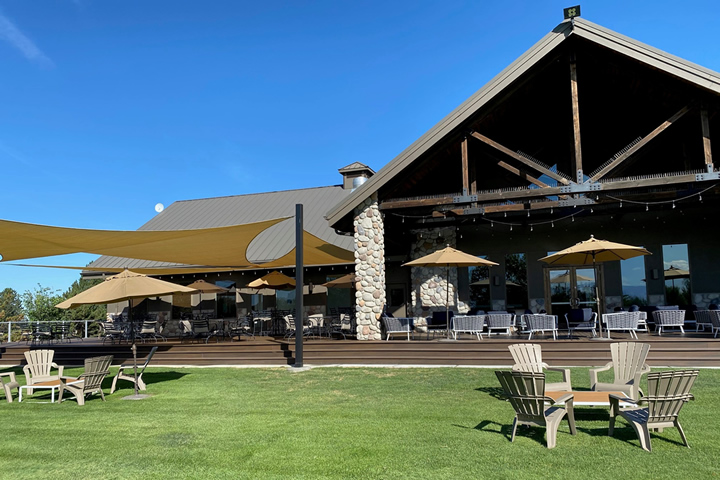
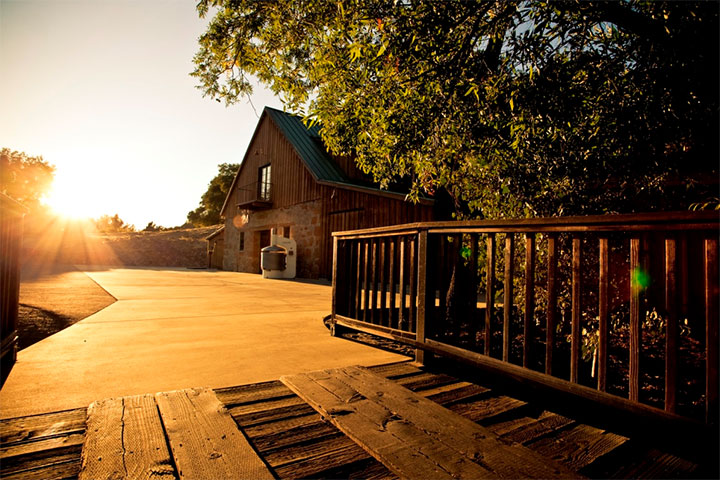
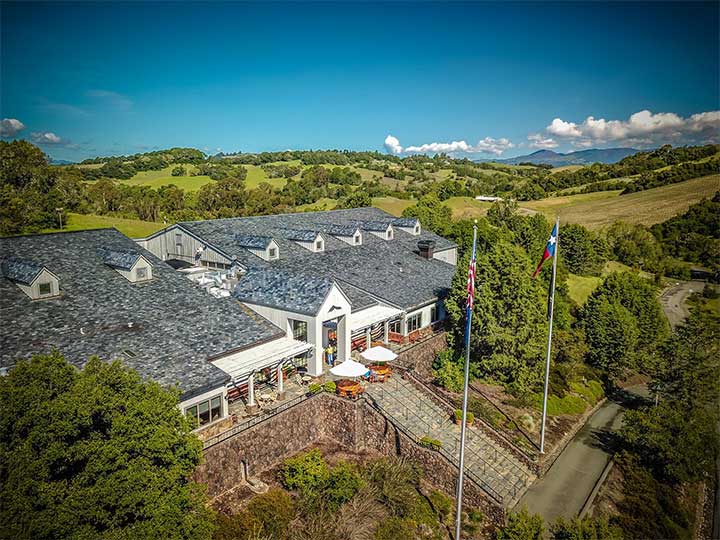
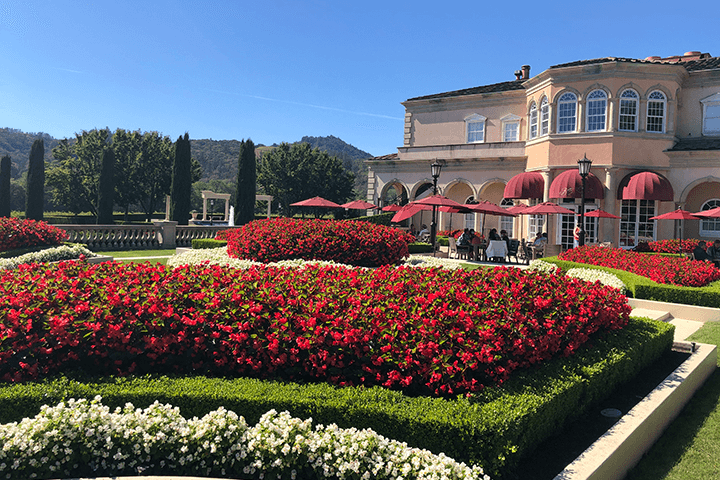
Three Rivers Winery Exterior 7 720

Walk among the stars at The Marcus Whitman Hotel
Go grand and feel like a mid-century globetrotter as you step into the lobby of Walla Walla’s most cherished luxury hotel, the Marcus Whitman. Both posh and historic, not only is it the tallest building in the region, but its floors have been graced by the likes of Dwight Eisenhower, Shirley Temple, and Louis Armstrong. Check-in and get comfortable in one of the tower suites with views unparalleled anywhere for miles. All amenities are first-rate, including the spa, the restaurant, and, yes, try some of the local wine downstairs at the Vineyard Lounge.

Soak in the sites and wine at Three Rivers Winery
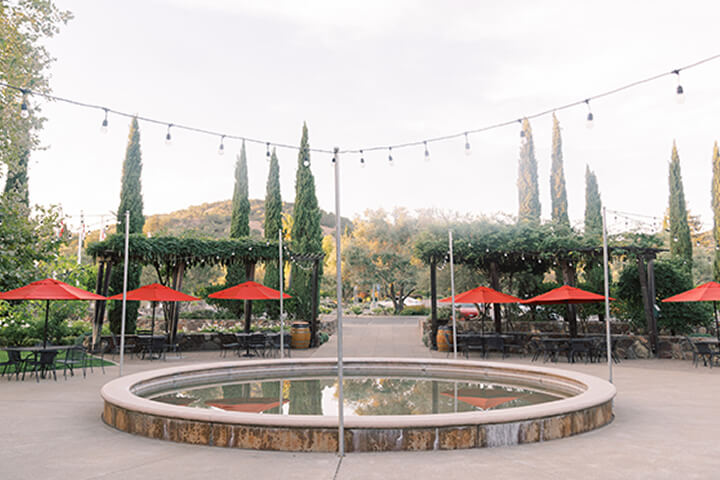
For over 20 years, Three Rivers Winery in Walla Walla has been producing some of the best wines in the Columbia Valley. Visitors are welcomed by the Blue Mountain skyline and pristine fields perfect for picnics and lawn games like cornhole and Giant Jenga. Sign up for the barrel room and cellar tour and upgrade your wine tasting with an unbridled cheese and charcuterie board. At Three Rivers, winemaker Holly Turner cranks out a handmade wine for every occasion—from lush, plummy Merlot blends and velvety Cabernet Sauvignons to crisp whites like Riesling and Sauvignon Blanc.

Taste local and seasonal cuisine at The Eritage
Extend the range of your adventure with a short drive north from downtown Walla Walla to the new Eritage Resort. Enjoy the scenic beauty as you dig into hearty creations from Eritage’s seasonal menu with entrees ranging from wild Alaska sturgeon steak to Porcini Sacchetti. Many of the ingredients used are sourced from local farmers within the eastern Washington region. Try to time your dinner reservation so you can take in the lake and sunset hour.

DUNDEE, OR
Four Graces Winery 720

Bocce in the morning, fireside drinks in the evening at The Setting Inn
Newly renovated and ready to serve, the Setting Inn is just a little way north of Dundee and provides arresting views of Willamette Valley’s vineyards and farms. Nestled on a sloping hillside, this is an ideal spot for a romantic getaway, adorned with modern decor and contemporary comforts. Wake to the distant mooing of cows in the pasture and wind down at night by the peaceful patio firepit. As upscale lodges go, this one ranks among the very best. They also have a nice bocce court (and you know you need to work on your bocce game.)

Get your Pinot game on at The Four Graces Winery
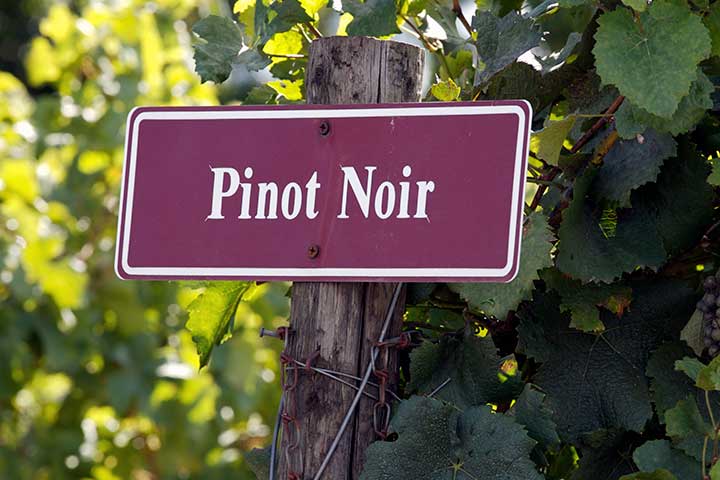
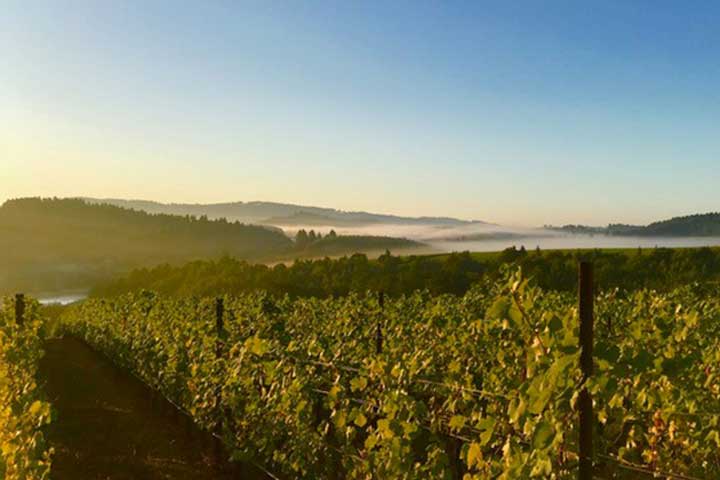
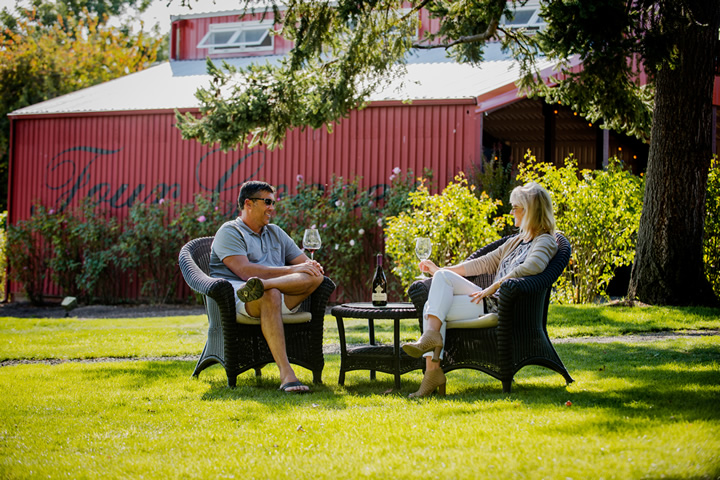
Wind your way through the morning mist while visiting this jewel of the Willamette River Valley. Full of cozy, rustic goodness, Four Graces Winery is a top spot for strolling through the vines, picnics under a cool moody sky, and of course, delicious wine tastings in a recently renovated historical farmhouse. When it comes to what wines are on the menu here, the specialties are rich, elegant, sustainably-grown Pinots of three different varieties: Pinot Gris and Pinot Blanc for the whites, and Pinot Noir for the red. If you’re lucky, you’ll get to meet winemaker Tim Jones.

A bit of Victorian charm at The Painted Lady
Head a short distance east to nearby Newberg to feast on some fine cuisine from this James Beard Award-nominated restaurant. Placed in a charming Victorian home, the Painted Lady is an excellent place to soak up the Willamette Valley atmosphere while dining on an eight-course tasting menu. Menu selections are seasonal, but be sure to try Mopsy’s Best sheep’s milk cheese with pickled cherries and their butternut squash agnolotti. Everything here satisfies, but to get the full experience, be sure to indulge in the wine pairings as well.

EUGENE, OR
acrobat biking 720x480 1

For introverts and extroverts: The Gordon Hotel
At once stylish and hip, The Gordon Hotel in downtown Eugene is the place to go for artists, creatives, and pet lovers. Lean into a meeting of the minds in some of the inviting social spaces, sample some locally-sourced eats at the Gordon Tavern, and get ready for the arrival of their new rooftop bar, Carlita’s (coming in the fall of 2021). The Gordon is right next to the 5th Street Public Market, home to some of the city’s greatest restaurants and full of shops with everything from artisan wares to chocolates and wine. While all the desired comforts are assured for introverts who like curl up with a book in front of the fireplace, this hotel is also perfect for extroverts who like a little social interaction with their wine.

Pilgrimage to Acrobat Winery at King Estate
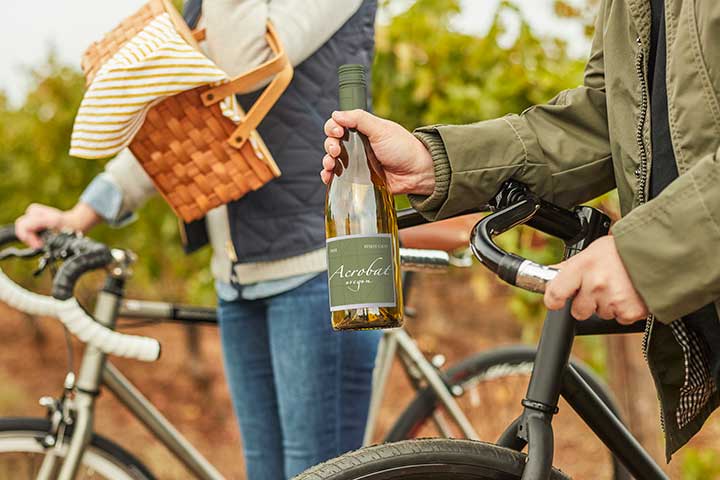
On the streets of Eugene, the name “Acrobat” holds a special place in the hearts of wine lovers with hometown pride. While Acrobat’s wines are now sourced from several vineyards across Oregon, the original home of the Acrobat brand is the nearby King Estate Winery. Use the Acrobat store locator to find one of their beloved Pinots and Chardonnays and sneak one onto your hotel’s veranda. But while you’re at it, do yourself a favor and make a pilgrimage to King Estate. Not only is it the home of Acrobat, but it’s also a sprawling tract of beautiful vines kissed by the morning fog.

A bit of French panache at Marché
A jewel of the 5th Street Public Market and a Eugene favorite, Marché is a French-based purveyor of fine cuisine with a casual romantic vibe. A James Beard Award semifinalist, Marché is known for its eclectic menu that evolves with the seasons. Reliable appetizers include their selection of “pizzettes” as well as their sea-fresh oysters on the half shell with a cucumber mignonette. As for entrees, they know their way around their steak and pork dishes. Be sure to save room for dessert: The vanilla panna cotta is a must.

Banshee Stakes Claim In Growing Sparkling Wine Segment With “Ten Of Cups” Brut

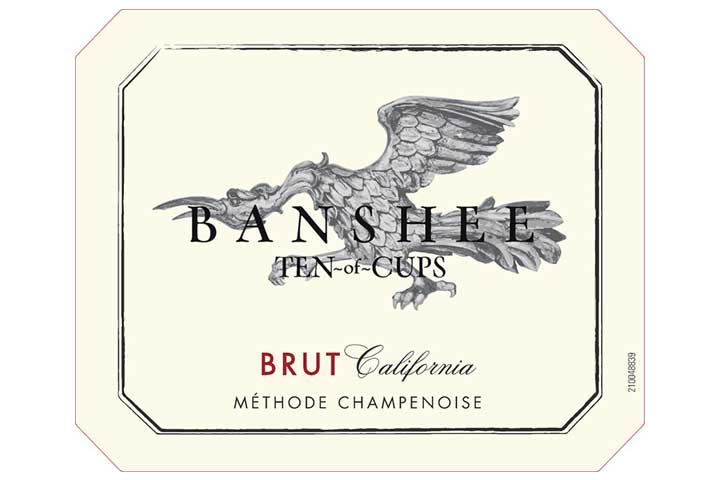
Healdsburg, Calif., September 16, 2021. Banshee Wines, one of the fastest growing luxury wine brands in the U.S., announces the release of their first sparkling wine in the Banshee portfolio, “Ten of Cups” Brut California NV. Inspired by the namesake Tarot Card, the limited-production release is crafted using the traditional Méthode Champenoise with a blend of Chardonnay, Pinot Noir and Pinot Meunier. Ten of Cups (SRP: $28.00) is now available online at bansheewines.com and will be released this Fall in select geographies across the U.S. National expansion will follow later in 2022.

“Foley Family Wines is excited to expand the fast growing Banshee portfolio with the addition of “Ten of Cups” Brut NV,” says Gerard Thoukis, Chief Marketing Officer. “We look forward to introducing existing and new fans of Banshee wine to our new sparkling offering.”

Founded in 2009, Banshee Wines defies conventions to create exceptional wines that are true to Sonoma County. Offering outstanding quality, Banshee produces affordable luxury wines of extraordinary balance, purity, and depth of flavor, crafted from California’s cool, rugged, coastal areas of the far western Sonoma Coast. In 2021, Alicia Sylvester joined Banshee as the winery’s winemaker, offering a fresh perspective on the site-specific wines on which Banshee has built its reputation.

“At Banshee, our goal is to craft distinctive wines that over-deliver in every possible way. With that in mind, we set our intentions to blend a sparkling wine that is true to Sonoma County through Banshee’s strong relationships with high-quality vineyards in the region,” says Banshee Winemaker Alicia Sylvester. “Ten of Cups is an exciting new addition to the Banshee portfolio; bright, vibrant, and deliciously drinkable.”

Ten of Cups Brut California NV is made with grapes sourced from some of California’s most notable vineyards, with secondary fermentation occurring in the bottle before aging for a minimum of two years. The resulting wine is vibrant, bright and aromatic with notes of tropical fruit, green apple and citrus complemented by marzipan and honeysuckle. Ten of Cups is persistent on the palate and creamy on the finish with hints of toast to round out the balanced and quaffable wine.

For media inquiries, or to speak with winemaker Alicia Sylvester, please contact Katie Orlady (korlady@colangelopr.com) of Colangelo & Partners. Download images and a tech sheet.

###

About Banshee Wines
Founded in 2009, Banshee Wines defies conventions to create exceptional wine for the true drinkers. Offering outstanding quality, Banshee wines produces affordable luxury wines of extraordinary balance, purity, and depth of flavor, with a focus on cool-climate Pinot Noir, crafted from California’s cool, rugged, coastal areas of the far Western Sonoma Coast. Banshee Wines joined the Foley Family Wines portfolio in 2018.

Winemaker Spotlight: Eric Baugher from Merus

Foley Food & Wine Society members, today, we’d like to introduce you to Eric Baugher, the new winemaker for Merus.

In short, Baugher comes to Merus after a very long stint at Ridge Vineyards, the Santa Cruz icon inextricably tied to the legacy of its founder, Paul Draper. But Baugher made a big name for himself, even ratcheting up two perfect 100-point scores along the way. He brings a tidal wave of knowledge and winemaking pedigree to Merus.

The first vintage entirely under his control will be the 2021 bottlings, which will be released in 2024. In the meantime, get to know this master of the vine—and be sure to get on the Merus allocation list before it’s way too late.

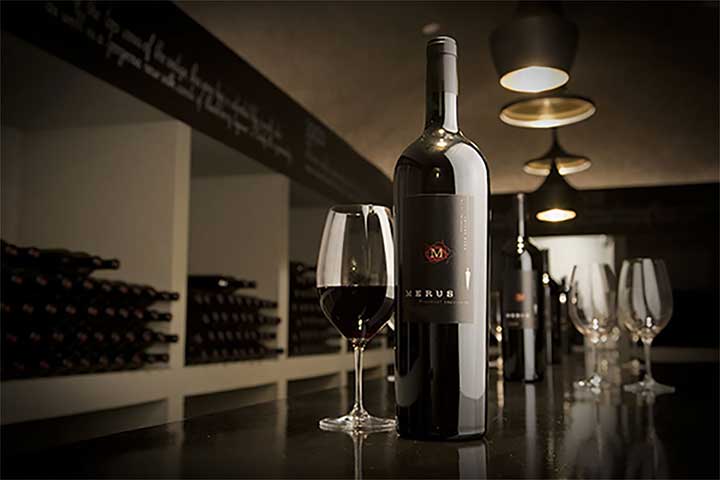
Merus About Pod720x480
Merus Winery in California.

FFWS: You grew up in Santa Cruz, California, and attended school at UC Santa Cruz. What did you study, and tell us about your first gig—at Ridge!
Eric Baugher (EB):
 I grew up in Santa Cruz, went to study at UC Santa Cruz, and raised my family there, near a beach. As a child, I loved gardening and farming. I did not, however, pursue agriculture as a career. Instead, I received my undergraduate degree in biochemistry and molecular biology. Having that scientific background allowed me to enter the wine industry via the laboratory at Ridge. Though I loved wine, having just become of legal age to purchase and collect, I did not have a good understanding of Ridge’s reputation before I started. I was mostly following the wineries on the western side of the Santa Cruz Mountains. (Ridge is remotely located on the eastern edge of the mountains, across the San Andreas Faultline.) I had yet to subscribe to wine publications or follow the who’s who of wineries. Once I joined, it became apparent that Ridge was quite famous, especially the man leading it, Paul Draper.

FFWS: You ended up staying at Ridge, working your way up to Assistant Winemaker, Head Winemaker, and then Chief Operating Officer. How did it begin?
(EB):
 Upon starting at Ridge, I intended to work for a year, during which I was to decide on my next academic journey. I was considering a Ph.D. in Biochemistry and then a research job in pharmaceuticals. The backup plan was dental school. Yet, in the summer of 1995, leading into harvest, the head chemist departed Ridge to pursue his Ph.D. Subsequently, the Production Manager also left to work at another winery. Suddenly, Paul was without help to manage the harvest and winery crew. I volunteered to remain on for the year and help. During harvest, it opened the world to many possibilities, and I was happily steered away from my prior plans.

FFWS: It sounds like winemaking came naturally to you. What do you think made it so?
(EB):
 I was intrigued by the natural winemaking approach and disciplined assemblage process in producing Ridge’s single-vineyard wines. I decided to continue another year, and then another, and so on. Paul must have seen something in me to give me the responsibility to manage the cellar and team. I also had a very precise tasting ability, and he recognized that taste memory was valuable for Ridge.

Paul continued to hand me more responsibilities as the years went on, including perfecting our winemaking techniques and pursuing greater wine quality. That allowed me to gradually rebuild many areas of the winery as gentle handling was a crucial aspect of making balanced wines with age-ability. The winery was also small enough that I could help out in many of the other areas of the business, working with some of the stars of the wine industry (the late Donn Reisen, who was head of sales; Wilma Sturrock, President; and David Gates, Viticulturist.) That gave me a well-rounded and full education on operating a luxury winery with the discipline of a First Growth Bordeaux château.

FFWS: Tell us about working with the legendary Paul Draper. What did you learn from him?
(EB):
 When I think back to those years, the most important lesson from Paul was to have grace and humbleness in how you conduct yourself; that pretentiousness and arrogance have no place in the wine community. He continues to be a very centered man and among the most important people I cherish in my life. I was fortunate to spend more than half my life working alongside Paul and to know him for the great man that he is.

FFWS: You must have spent a slew of afternoons meeting and tasting with some of the most legendary people in the wine industry.
(EB):
 In my time at Ridge, we received many high-profile visits regularly. The closest visit by a President was Obama flying air-force one right over Monte Bello vineyard as he came to visit the Bay Area. The Clinton’s White House Chef told me once how Monte Bello was a favorite of the President. We also had a few other administrations serve Ridge wines for various State Dinners at the White House and a few international G7 dinners. Ridge, having a great export program to 50 different countries, the reputation was global and led many top Master Sommeliers and Masters of Wine to visit regularly.

One of the last big events, before Covid, we hosted fifty MW’s and opened a five-decade span of Monte Bello’s to showcase the aging potential of this great vineyard. In 2011, at our 50th Anniversary celebration, we had a group of international and top national journalists visit. Of course, this was the year it would not stop raining. We went to visit several vineyards, getting drenched with rain and hit by hail. The vines were barely visible with the amount of weed growth. This was when Jancis Robinson MW coined the term “smother crop.” Once things dried out enough, we had to get onto some serious mowing to knock the weeds and grasses down.

FFWS: You earned two 100-point scores during your time at Ridge. One for the 2013 Ridge Montebello from Jeb Dunnuck when he was on staff at Robert Parker’s Wine Advocate, and again from Jeb Dunnuck for the 2017 Ridge Montebello. What did it feel like to have a critic profess that a wine you produced is a perfect wine?
(EB): 
It’s heartening to know when a critic recognizes something in a wine that I already feel, from the beginning of time tasting fruit on the vine, watching it ferment, combining lots at the assemblage, following the wine to bottle. The 2013 and 2017 vintages both evoked those awe-inspiring emotions. They were both superlatively rich, complex, and powerful in their expression of terroir. The shocking difference is that 2013 was a drought year; 2017 had torrential rains that lasted into June. Yet, both wines showed incredible intensity. I believe the success was from having grown in experience, getting through similar tough vintages, and handling the fruit differently. It also helped that the vineyard yield was low in both vintages.

FFWS: After such a long tenure at Ridge, what excited you about joining Merus?
(EB):
 Again, having spent half my life working at one winery, I was getting to the point of homeostasis. You could also say monotony. The challenges I was given were no longer stimulating enough and I was gradually being pulled away from the hands-on winemaking that I loved most. Being a small boutique winery, Merus has given me an amazing opportunity to return to active winemaking and use all my experience to improve the wines and the vineyard. The estate vineyard is receiving a complete redevelopment and I’m making improvements to winemaking techniques that will dramatically raise quality and consistency of style. After all, that is the hallmark of all luxury wines, providing incredible drinking enjoyment consistently every vintage.

FFWS: What have you tasted recently from the cellars at Merus?
(EB):
 To understand Merus, the style variations through the vintages, I did go through the reserve. Sadly, there aren’t many bottles of many early vintages. One that stands out is 2006. It was utter perfection in what I love about cabernet that has some bottle age. It was deep in color, opulent, silky smooth tannins, and had great persistence in the finish. Any collector that has that vintage should be quite lucky to have that year.

FFWS: Tell us a little about your cellar at home – what do you like to drink when you’re not tasting your own wines?
(EB):
 Currently, my home cellar is packed with Ridge wine. I had amassed a very large collection during my twenty-seven vintages. I am working on it, enjoying bottles before they’ve gone over the hill, trying to make more room for the wines of Napa Valley and Bordeaux. Honestly, I love all wine and any variety. Some get me more excited than others, with Bordeaux being at the top. There is something very special about Cabernet and related grape families, in how well they show their terroir, how they are grown, and the alchemy of how they are blended. I have a great collection of Bordeaux blends. The trouble is when it comes time to opening a bottle and worrying if I’m enjoying it too soon. I love wine with bottle age, perhaps past what most consumers enjoy. I suppose that is the second great thing I learned from Paul Draper, the love of wines that have moved into secondary and tertiary flavors.

favorite cabs merus

FFWS: What will be your first official vintage of Merus in the books? And in the meantime, what wines should Merus fans be stock-piling? What is an excellent wine to start with Merus for the uninitiated?
(EB):
 Though, not a wine that I made from the start, rather one that I finished in order to prepare for bottling, once I joined Merus, is the 2018. That has my strong recommendation to stockpile. It is sensuously deep and has a rich texture. 2019 is currently in the cellar continuing to be worked on by myself. 2021 is my first official vintage and should be an exciting one with the exceptional growing season we are experiencing in Napa Valley. As for a great starter vintage for a new collector to Merus, I find the 2016s to possess an excellent balance of tannins and fruit. It has a suppleness with its saturated dark berry fruit covering tannins. It’s a seductive vintage that will capture collector’s hearts and make life-long fans of Merus.

How Much do You Know About Cabernet Sauvignon?

Cabernet Sauvignon is a grape variety that we do well at several of our Foley family estates. But how much do you know about this prized grape?

We poured through one of our favorite wine books to dig up some interesting facts about this stately variety. “Wine Grapes: A Complete Guide to 1,368 Vine Varieties, Including Their Origins and Flavors” authored by Jancis Robinson and co-authored by Julia Harding and José Vouillamoz, is the more than 3,000-page tomb we’re talking about. It’s one of those must-have wine books for any lover of wine. And whether you refer to it all the time, or periodically, or for that one moment when you’ve just got to find out some fact about your favorite variety, it’s the most reliable and exciting source for all things grape.

While Cabernet Sauvignon is the indisputable King of Napa, it plays a prominent role in France’s Bordeaux region, particularly in the Left Bank—and is a leading variety in other parts of the U.S. and the world. Below, you’ll find some interesting facts about Cabernet Sauvignon, along with a few recommendations from our portfolio of wines.

1. ORIGINS. Where in the world does Cabernet Sauvignon originate?

Cabernet Sauvignon comes from the Gironde in south-west France. It was first listed for sale in a catalog of grape varieties in Pauillac in 1784. So, in the spirit of Cabernet’s origins, we’ve selected two wines that are made in a kind of Bordeaux-style, in terms of their aging in extremely high-quality French oak and their ability to cellar beautifully.

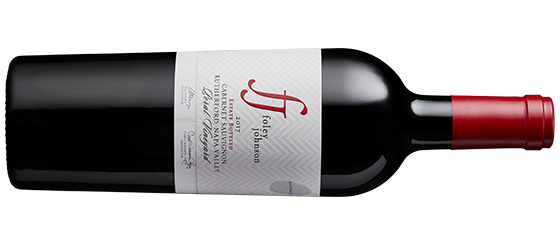
2017 Foley Johnson Estate Cabernet Sauvignon, Rutherford, Napa Valley

2015 Kuleto Estate Cabernet Sauvignon, Napa Valley

2. PARENTS. Can you name the parent grapes of Cabernet Sauvignon, and the UC Davis professors who made the hallmark discovery?

Cabernet Sauvignon is the offspring of Cabernet Franc and Sauvignon Blanc! In 1996, Carole Meredith and John Bowers of the University of California at Davis made the discovery. What better way to celebrate the parental origins of Cabernet than with the pinnacle, the patriarch (or matriarch if you will) of our limited-production offerings from Firestone? The Chairman Series should be on your radar, and if it’s not, here’s your chance.

2017 Firestone Vineyard Chairman Series Cabernet Sauvignon

3. ON THE VINE. If you saw Cabernet Sauvignon in a crowded lineup of grapes, could you pick it out?

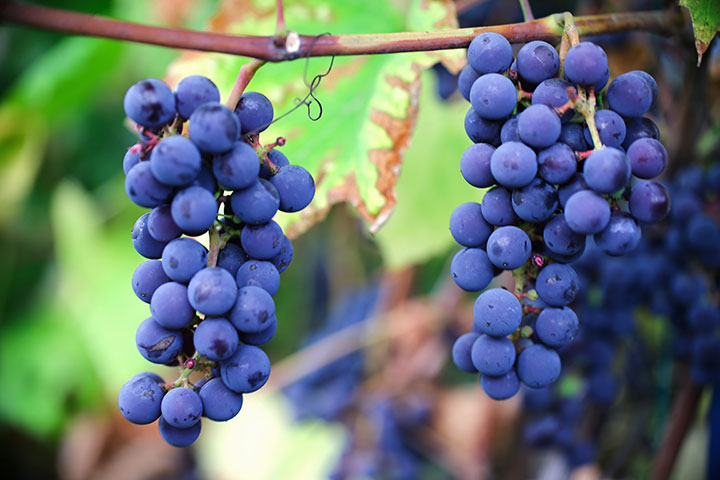
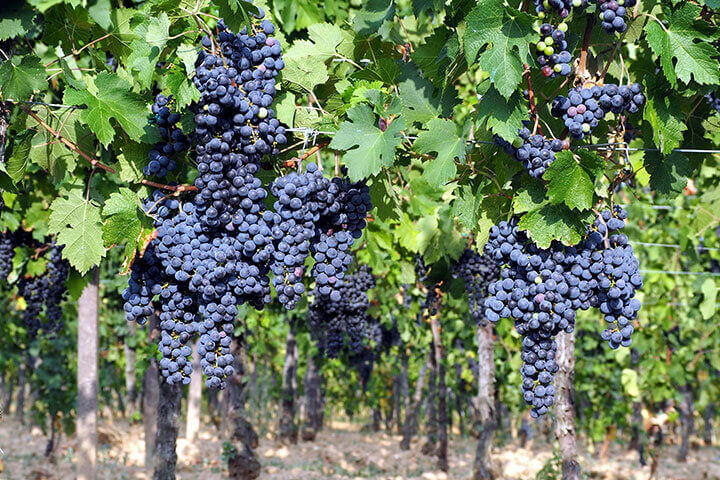
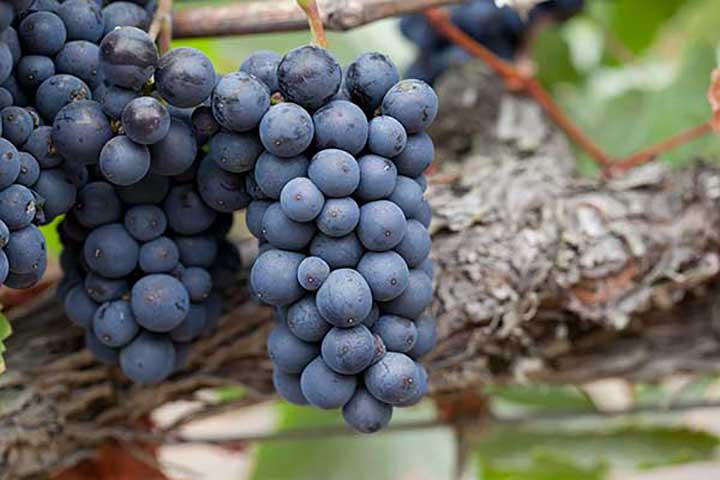
You’d be looking for a grape bunch that contains little berries that are not very tightly-packed together but rather loose, and they’d have relatively thick blue-hued skins. If you’re looking for a purple-hued, blueberry-kissed ultra-powerful, and delicious rendition of Cabernet Sauvignon, look no further than these two beauties.

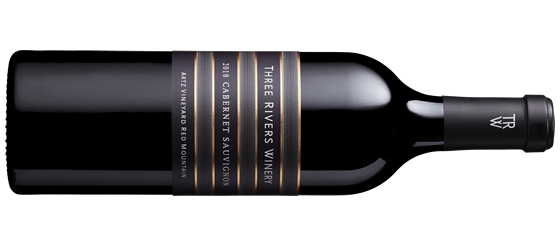
2018 Three Rivers Cabernet Sauvignon Artz Vineyard, Red Mountain, Columbia Valley

2017 Roth Estate Winery Reserve Cabernet Sauvignon Learn More

grape vines

4. BLENDING. Which grape variety is most commonly blended with Cabernet Sauvignon and why?

Cabernet is often blended with Merlot, which is softer and fruiter, and helps to balance Cabernet’s typically powerful, mouth-drying tannins. If you’d like to see this kind of blending trick in action, we suggest the following Cabernet blends, which leverage the plumy, juicy, softening power of Merlot!

2018 Banshee Cabernet Sauvignon, Napa Valley

2015 Ferrari-Carano Tresor, Alexander Valley

5. TOP DOLLAR. Some of Napa Valley’s most famous wines are comprised of Cabernet Sauvignon, and many of them fetch top-dollar. But do you know how much it costs vintners to purchase the best Cabernet grapes?

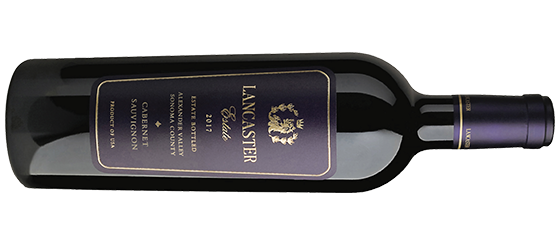
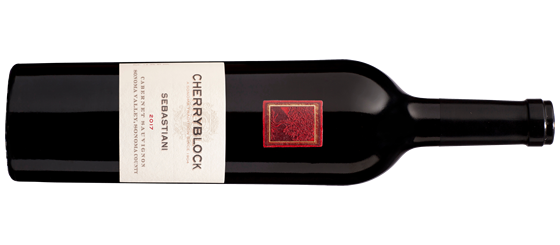
If you had to put a dollar amount on one ton of prime Cabernet grapes from Napa what would you pay? According to the California Grape Crush report, of all the grapes that were crushed in California in 2019, Cabernet Sauvignon comprised 14.1%, second only to Chardonnay, which made up 15.6% of all grapes crushed in 2019. And one vintner paid $50,000 for one ton of Cabernet grapes from legendary grower Andy Beckstoffer!! If we sold our Cabernet grapes for Sebastiani Cherryblock or our Lancaster Estate Cabernet, we’d probably consider charging $50,000 too—but to be honest, we consider them priceless assets. Well, not invaluable, but certainly not $50,000 for one ton, because then, we’d have to charge about $500 per bottle. So, coming in at far less than that price, and two of our finest examples of Cabernet Sauvignon are just a click away:

2016 Sebastiani Cherryblock Vineyard Cabernet Sauvignon, Sonoma Valley

2017 Lancaster Estate Cabernet Sauvignon

10 Gameday Wines to Drink All NFL Season Long

There’s always something happening in the air after Labor Day. Is it that the kids are back in school and you have to wake up early again? Or is it that unmistakable feeling of excitement mixed with anxiety knowing we’re at the start of the annual holiday blitz? It’s a little bit of all that, but speaking of blitz

The days following Labor Day mark the start of the new NFL football season! So, when you’re in your pre-game-day mode, combing the grocery aisles for barbecue meats, chips, (and cookies shaped like little footballs), don’t forget to take your game-day ritual up a notch with some fine wines to share with your guests throughout the season.

Here, we’ve culled together some of our hardest-hitting wines. One sip, and you’ll swear you just got pummelled by eleven large men. But don’t worry, you can get right back up and do it all again. Hut, hut, hike!

OUR TOP PICKS FOR NFL GAMEDAY WINES

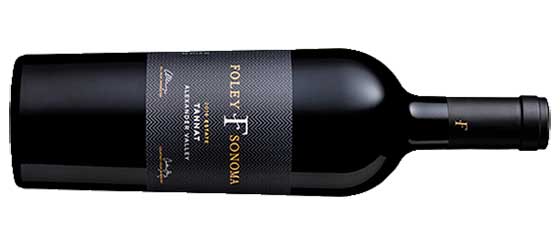
2017 Foley Sonoma Winemaker Series Cabernet Sauvignon Alexander Valley

2017 Foley Sonoma Cabernet Sauvignon Winemaker Series, Alexander Valley
93+/100, Robert Parker’s Wine Advocate
Terroir-driven, leveraging the incredibly brawny quality of Tannat to complement Cabernet Sauvignon, Petit Verdot, and Cabernet Franc—not unlike the brawny qualities of a linebacker, and believe us, this wine is built like one. In fact, you’d be better off getting crushed by a linebacker than having a pallet of this red (that’s a crate of 56 cases of wine) dropped on you during some gameday celebration gone wrong. Only, don’t try and twist a corkscrew into an actual linebacker, because that is sure to end in a messy and rather public display of football fandom. Anyway, best to enjoy copious amounts of this wine while yelling “all the way!” at the television.

FOLEY SONOMA TAKES THE LEAD!

8185 560 GCCNHU

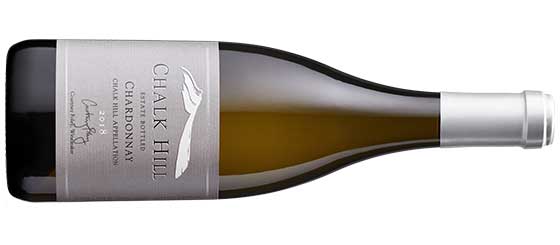
2018 Chalk Hill Estate Chardonnay, Chalk Hill AVA
92/100, Robert Parker’s Wine Advocate

The Tom Brady of our wine selection? That would be Chalk Hill’s Chardonnays. Sure, we know it’s a controversial statement, but Tom Brady’s a controversial man, marrying together consistent dominating talent with eyebrow-raising intrigue. Similarly, Chalk Hill churns out some of the most intoxicating Chardonnay wines year after year, like a train of pure force that never goes off the rails and choo-choos its way onto your taste buds. This creamy and decadent 2018 vintage has a dream team of aromas with everything from orange blossom, crisp apple, vanilla, and toasted marshmallow. It’s enough to bring your adversaries to tears. Here’s to a wine that will never leave you deflated.

FIRST STRING CHALK HILL QB FOR THE WIN!

1382 2017 Sebastiani Cherryblock

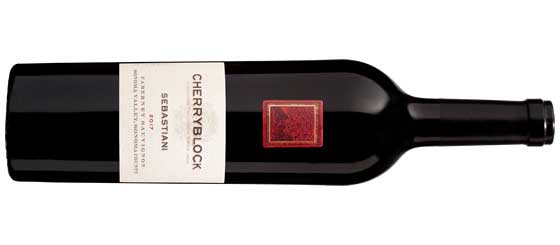
2017 Sebastiani Cherryblock, Cabernet Sauvignon, Sonoma Valley
93/100, Robert Parker’s Wine Advocate
Football legend Joe Namath once said, “If you aren’t going all the way, why go at all?” Based on that quote alone, we’re willing to bet he’s also a fan of Cabernet Sauvignon. In particular, we think he might enjoy this 2017 Cherryblock bottle of 100% Cab from Sebastiani, combining the smooth aromas of vanilla and blackberry with spiced layers of tobacco and cedar. A player of his stature could genuinely appreciate the tannins–soft as a billowy pair of sideburns–that adds to the texture of this sturdy Cabernet and pairs exquisitely with any hunk of American-grown red meat.

CHERRYBLOCK GOING ALL…THE…WAY!

2018 Zinfandel

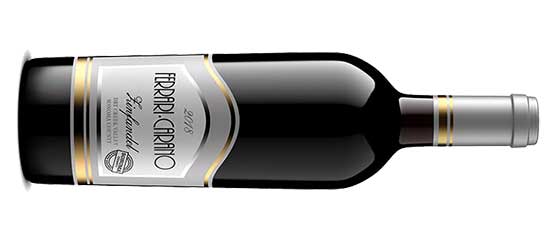
2018 Ferrari-Carano Zinfandel, Dry Creek Valley
This wine is a peppery and dark fruit-driven bottle of pure Zinfandel cold-soaked in stainless steel and cave-aged in French Oak barrels. You’ll notice Ferrari-Carano shares half of its name with a maker of beautiful Italian cars and you can imagine a car just like that revving up on the football field and “going long” at full speed across the astroturf as it makes its way towards the end zone. It seems unusual, but that’s the only accurate way to describe this wine. As a bonus, this bottle pairs perfectly with, among other things, sharp cheddar cheese and chili, so if you’re looking for a bottle of wine out there in this crazy world that’s a natural fit with your game day nachos, this is the Zin for you.

Out of Stock – Contact for Availability

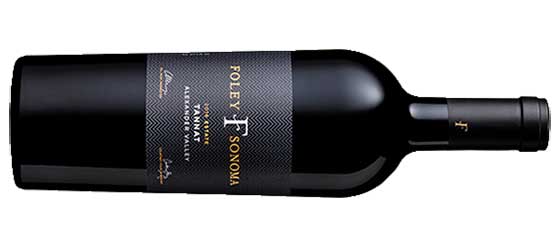
Foley Sonoma 2016 Estate Tannat

2017 Foley Sonoma Estate Tannat, Alexander Valley
Tannat might be a grape that flies under the radar of its more popular cousins. But if you’re diving into a Tannat wine head first, be warned that it packs a punch. Though this particular bottle from the Foley Sonoma Estate has smooth wispy tannins and refined acidity, you’re more likely to notice the raw, unabashed power behind the grape. When the wide receiver catches the ball, but then gets tackled by every player of the opposing team, that’s Tannat. When the quarterback runs with the ball along the foul line, but trips and tumbles into the Gatorade keg, that’s Tannat. Put on your safety pads and see what Tannat is all about.

TACKLE THIS FOLEY SONOMA TANNAT!

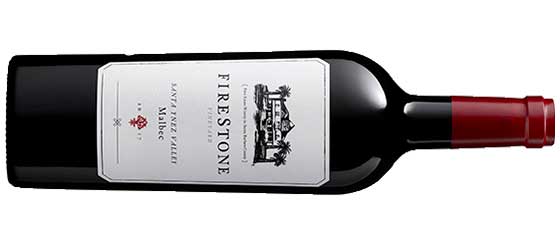
Firestone Vineyard 2017 Malbec

2017 Firestone Vineyard Malbec, Santa Ynez Valley
Most Malbec wines are produced in Argentina or Chile. Down there, football is a different sport entirely where the players aren’t even allowed to touch the ball with their hands. But in the United States, we have our own game of football where players can handle the ball with any part of their body regardless of whether it makes any sense. That’s what American freedom’s all about! To celebrate the American style of football, we have an American style of Malbec from Firestone Vineyard, grown in California’s Central Coast. With toasty plum and tobacco aromas and red fruit flavors, there’s no better spokes-wine to promote the flavor of America.

AMERICA-MADE GAMEDAY MALBEC

93634 560

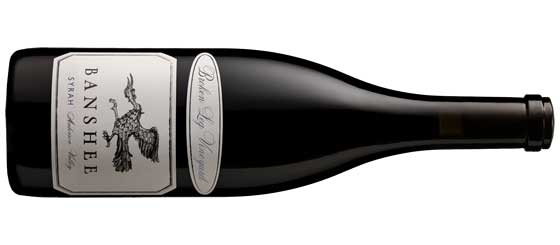
2016 Banshee Broken Leg Vineyard Syrah, Anderson Valley
Emulating the flavors of popular Syrahs from the northern Rhône, this wine has notes of spiced black cherry and was heavily influenced by its terroir. Deep and intense, this bottle from Banshee will leave you screaming like a football player with a newly broken leg. But in a good way! So raise a glass to the players with unfortunate injuries. They sit on the bench eating tangerines all season long in a cast while the rest of the team juggernaut Hail Mary’s its way to victory. Even during all their physical therapy appointments, these players still know how to rah-rah with the rest of the crowd and no wine helps soothe an athlete with a broken bone quite like Syrah.

UNCORK THIS BROKEN LEG!

40084 560

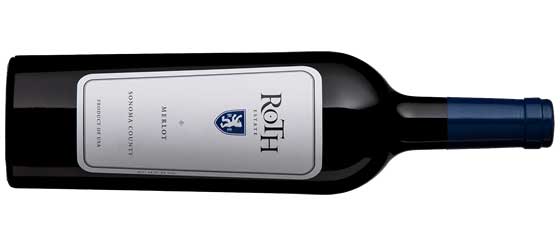
2016 Roth Merlot, Sonoma County
Gold Medal, 92 Points – Press Democrat North Coast Wine Challenge
Silky, rich, earthy. This is a Merlot of pedigree, with plum and spice notes to fire the synapses in your brain. This 2016 vintage from Roth isn’t only a fine representation of Sonoma Merlot; it’s also the perfect wine for football coaches. You know the type: Furrowed brow, arms crossed, an anxious look on their faces as if a bunch of trick-or-treaters showed up on their porch in the middle of July. The coaches are out there playing 3D chess with lifesize figurines that keep ramming into each other, and we all know that can’t be easy. That’s why we drink Merlot. It’s a wine for deep thought, clever strategizing, and maybe even cracking a smirk in the middle of tense competition.

THINK LIKE A COACH MERLOT

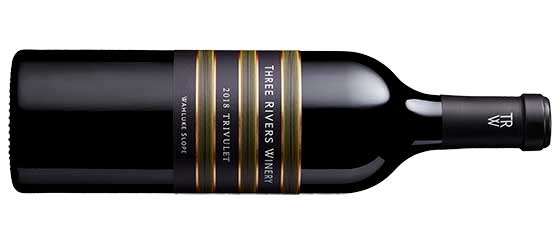
006483 2018 Three Rivers Trivulet Wahluke 5601

2018 Three Rivers Trivulet Red, Wahluke Slope
91 Points – Anthony Dias Blue
In the spirit of teamwork, we present this floral and raspberry-scented red blend combining the classic mingling of Merlot with Cabernet Franc. This wine has an old-world aura that helps keep this timeless varietal-blending alive. As the grapes for this wine hail from Washington State, it might be a great wine to drink while rooting for the Seahawks, but get a little creative. Maybe the name Three Rivers will bring to mind the hometown for another great football team, The Pittsburgh Steelers, as Pittsburgh sits at the confluence of three mighty rivers. Thankfully though, you can enjoy this wine while rooting for any team. Even the New York Giants!

GO, GIANTS! GO STEELERS! GO SEAHAWKS!

105647 2018 Foley Estates Syrah

2018 Foley Estates Syrah, Sta. Rita Hills
This Syrah grew out of the very cool climate of Sta. Rita Hills and features an earthy flavor with supple tannins. The aromas here are evocative of blue and black fruits, so this is the perfect wine for fans of teams sporting blue in their uniforms: Dallas Cowboys, Tennessee Titans, New York Giants, and the like. We can sense some football fans from Wisconsin giving us the stink eye here. “What about us Green Bay Packers fans,” they ask, “with our green and gold jersey?” To that, we say don’t worry, Packers fans, this Syrah pairs excellently with your homegrown cheese, even if you wear that cheese on your head.

IT’S A SYRAH TOUCHDOWN!

Cabernet Day is Today! Stock up on Our Top Bottles

Finally—the day you’ve been waiting for all year is here! We’re not talking about your birthday or wedding anniversary (those days pale in comparison). We’re talking about National Cabernet Day!

September 2, 2021, is Cabernet Day, and the timing couldn’t be better. Heading into the Labor Day weekend we expect every Foley Food & Wine Society member to be firing up the grill and picking out some stunners from the cellar. We know you’ll be popping loads of corks, and so, naturally, you’ll need to replenish in time for the upcoming holiday season.

We’ve put together a list of our top Cabernets that are primed for your cellar. So, settle into your favorite lawn chair, grab a glass of Cab, and pick our your favorites.

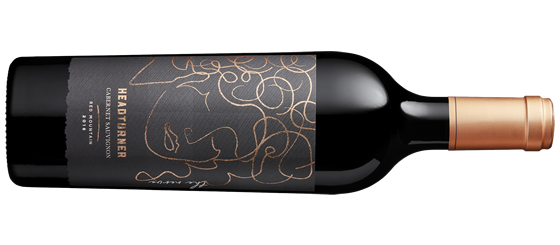
106484 2018 Headturner CabSauv RedMountain 560 2 1

2018 HEADTURNER THE NERVE CABERNET SAUVIGNON, RED MOUNTAIN ($30)

Winemaker Holly Turner tapped the Artz Vineyard in Washington State’s highly coveted Red Mountain AVA to craft “The Nerve,” which earned 91 points and an “Editors’ Choice” award from Wine Enthusiast! Here is what reviewer Sean Sullivan had to say: “This is an appropriately named, attention-getting wine. The aromas draw you into the glass with notes of dried herbs, plum and black currant. The flavors are fresh and lively, with a lightly grainy feel to the tannins and pleasing depth of flavor.” With 21 months of aging in expensive French oak, we call it one of our best Cabernet bargains! See for yourself.

6467 2018 ThreeRivers CabSauv Artz RedMtn 560 2

2018 THREE RIVERS ARTZ VYD CABERNET SAUVIGNON, RED MOUNTAIN AVA ($45)

Holly is at it again, this time with a slightly different rendition of the same Artz Vineyard on Red Mountain for Three Rivers. Aged 17 months in mostly new French oak, this elegant beauty caught the attention of Robert Parker’s Wine Advocate, which awarded it 90 points and described it as, “Beginning with the classic rustic mineral tension of Red Mountain, the 2018 Cabernet Sauvignon Artz Vineyard showcases dusty dark cherry with elements of blackberry skin, current and cassis with dusty oak essence. Full-bodied, the wine offers ripe black fruit flavors with a rusticity, gripping tannins and mineral tension across the mid-palate. It ends with flavors of black raspberry, bitter dark chocolate, dark cherry skin and persistent dusty floral tone on the long, lingering finish,” and concluding with this directive: “Give it a try.” So, what are you waiting for?

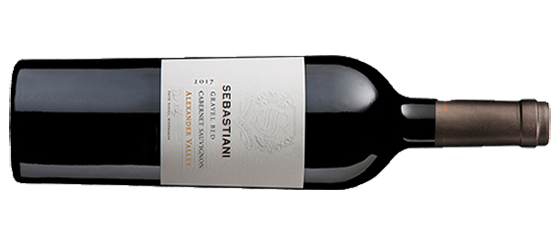
001375 560 Sebastiani 2017 Gravel Bed Cabernet Sauvignon GDYZPS

2017 SEBASTIANI GRAVEL BED CABERNET SAUVIGNON, SONOMA COUNTY ($72)

Gravel Bed vineyard is the rockiest site that Sebastiani farms and the fact is, that rocky sites are among the best sites for growing top-shelf Cabernet. Why? It’s all about drainage. The best vineyards are well-draining vineyards, where water doesn’t have a chance to puddle, and vines have to send their roots snaking through the soil in search of nutrients. The effort exerted by the vine is what we call “vigor” and it leads to two great things: structure and concentration. Exhibit A: This Gravel Bed Cabernet is a deeply flavored, bold red bursting with blackberry and dark cherry notes, laced with graphite, espresso, and dried wild herbs on a long finish. The tannins have an almost black tea-like quality to them, with a softness that does not belie the profound structure. We suggest sipping this on its own at cellar temperature in your biggest Bordeaux stems. Enjoy.

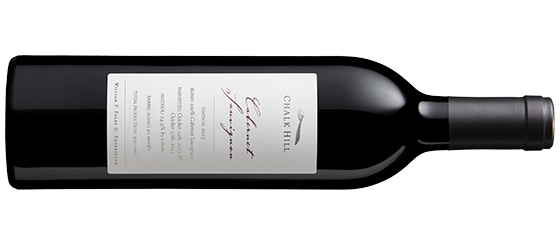
8124 560 KHHIMY

2017 CHALK HILL CABERNET SAUVIGNON, CHALK HILL AVA ($90)

For all you lovers of our Chalk Hill Chardonnay, we’ll be deeply saddened to learn that you’re not stacking our Chalk Hill Cabernet nearby in the cellar. After all, there’s no better follow-up to a Chalk Hill Estate Chardonnay than an already-decanting bottle of this fine Cabernet. Aged for 18 months in 75% new French oak, it displays all the things that make Sonoma County Cabernet an often dead-ringer for Left Bank Bordeaux (even more so than Napa!) Leading with lifted aromas of black cherry, spiced plum, and tobacco leaf, and unfolded on the palate with rich, bold dark fruit flavors and sumptuous earthy notes all framed by velvety tannins tinged with vanilla bean. This is a wine that pairs well with your expertly salted Ribeye, and yeah, helps wash down that last spoonful of vanilla bean ice cream during dessert too. It’s a Cabernet for rulebreakers and classicists!

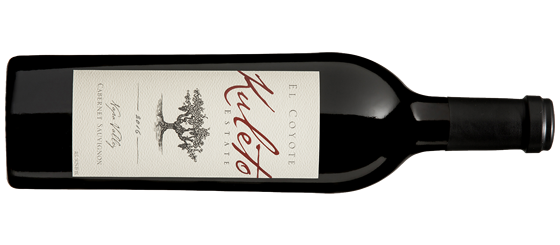
7367 560

2016 KULETO EL COYOTE CABERNET SAUVIGNON, NAPA VALLEY ($100)

“If you like your Cabernet big, flavorful, and chewy, this is the one for you from the 2016 vintage,” says John Clews, who crafted this “El Coyote.” It’s not that there’s a vineyard named El Coyote, it’s more a howling kind of feeling exhibited in the grapes harvested for this red, which shared a common thread of structure and flavor, which errs on the side of dark, meaty, rich, and savory. Also, the 2016 vintage is on par to be one of the greatest (so add these to your piles of 2013s, 2014s, and 2018s). Clews describes: “Dark blue-black fruit aromas tangle with those of darkly charred wood and blackened meat. It’s very primal-smelling. In the mouth, it lunges straight to the mid-palate then lurks under the tongue and coats the sides.” Anything less than smoked ribs and plates of charcuteries while enjoying this red, would arguably be uncivilized.

40534 2017 Lancaster Estate Cabernet Sauvignon 560 HMVFDH2

2017 LANCASTER ESTATE CABERNET SAUVIGNON, ALEXANDER VALLEY ($115)

Here’s another hit sleeper vintage! The utterly expensive oak used to age this Cabernet for two full years includes Darnajou, Taransaud, Demptos, Ermitage, Saury, Bel Air, and Sylvain. If you follow the French cooperages (we know at least two of you do) you’re wondering how this wine isn’t triple the price. Erin Brook, reviewer for Rober Parker’s Wine Advocate rather enjoyed her glass, describing a 91-point “nose of blackcurrants and cherries with accents of loamy earth, cedar, dried herbs and sweet spice. The palate is full-bodied with lush fruits and a minerally undercurrent, grainy and with just enough freshness on the finish.”

009303 560 2017FoleyJohnsonPeralVineyadCabernetSauvignon2

2017 FOLEY JOHNSON HANDMADE PERAL VINEYARD CABERNET SAUVIGNON, RUTHERFORD ($120)

From our Rutherford-based estate comes this single-vineyard Peral Cabernet. Peral is a 10-acre site adjacent to our Foley Johnson Rutherford Estate. (So, if you’ve ever enjoyed a flight on the patio there, you’ve eyed these vines). Believe it or not, the site used to be a pear orchard. But fear not, the pear trees are gone, and this is no fruit wine. It’s one of the finest Cabernets we produce—and very little of it is produced each year. The 2017 vintage is all of 209 cases and earned a glowing review from Wine Spectator: “Restrained in profile, with moderate plum and black cherry puree flavors forming the core, while light alder, sassafras and anise notes check in. The tight-grained finish has just a blip of the vintage’s rusticity at the very end. Drink now through 2030.” This is one to decant and try to keep at cellar temperature if you can, and if not, give it a good swirl to release the aromas. You could enjoy half a bottle today, and the rest the next day and it will still show exceptionally well. Pair it with this burger.

1382 2017 Sebastiani Cherryblock 560

2017 SEBASTIANI CHERRYBLOCK CABERNET SAUVIGNON, SONOMA VALLEY ($140)

The 2017 release of Cherryblock comes from a challenging year, but the vines performed beautifully and Robert Parker’s Wine Advocate handed over a 93-point score, describing “slowly opening scents of cherry jam, tar, grilled meats, dried rose petals and graphite touches. The medium-bodied palate has excellent restraint and great balance of fruit, savory and spicy character, and it’s firm but finely grained and fresh with a long finish.” Pair it with this Ribeye recipe!

Sebastiani’s crowning achievement is none other than its Cherryblock Cabernet Sauvignon. But there’s an air of mystery surrounding the vines that produce Sebastiani’s legendary Cherryblock Cabernet Sauvignon. Samuele Sebastiani first purchased the site on which the vines are planted in 1919—the year Prohibition was ratified. But instead of planting grapes, he planted a cherry orchard. The first grapevines arrived in 1961 and 1962, planted by August Sebastiani, on traditional St. George rootstock—but no one knows the true origins of where the budwood originated, and August left no detail or receipt from any nursery. Whatever their origins, they are superior quality vines!

How Much do You Know About Pinot Noir?

As one of the most popular, light- to medium-bodied red wines in the world, there’s a good chance that you love Pinot Noir; but how much can you truly love it without knowing its full story?

To get that full story, we once again consulted with one of our old favorites, Master of Wine Jancis Robinson’s Wine Grapes: A Complete Guide to 1,368 Vine Varieties, Including Their Origins and Flavors, co-authored by Julia Harding and José Vouillamoz. With over 3,000 pages, it’s perhaps the most comprehensive book on the subject and a must-own for any lover of wine who wants to deep dive into the world of their favorite wine flavors.

Now that we’ve properly gushed about one of our favorite books, here’s a little overview of one of our favorite grapes. Pinot Noir is known for its high acidity and low tannins with fruity and spicy flavors. As delicious as it is, the grape is also famous for its temper and thrives only under the most particular of circumstances. With that said, there are plenty of notable hot spots for growing Pinot Noir all around the globe. Let’s get to know Pinot Noir a little better with some fun facts and some shining examples.

HOW STURDY IS THE PINOT GRAPE?

The term “thin-skinned” has never been more applicable, or literal, as when it’s used to describe Pinot Noir. It’s very fussy about its growing conditions, preferring temperate climates and calcareous clay soils. As Robinson puts it, “In hot climates, it ripens too quickly and the relatively thin-skinned berries tend to shrivel and are subject to sunburn.” Pinot also is susceptible to maladies like mildews, rots, and leafhopper-related issues. Fun fact: Chardonnay enjoys the same growing conditions as Pinot Noir, so it’s not uncommon to find the two growing side by side.

From a single vineyard in Carneros, where extremely cool temperatures and strong winds create Pinot Noir with slightly thicker skins, this is one dynamite, richly-imbued Pinot to try:

2018 SEBASTIANI ROBERT’S VINEYARD PINOT NOIR, CARNEROS

pinot grapes

WHAT ARE SOME NOTABLE PINOT NOIR REGIONS?

Pinot Noir thrives in cooler regions with a maritime climate. Some of the most prestigious—and ageworthy—Pinot Noir wines in the world hail from the Côte d‘Or in Burgundy, France. There, sumptuously earthy, layered, and elegantly perfumed Pinots are the norm and understanding quality is all about understanding the appellation hierarchy system, which is similar to our AVA system in America.

In California, the hot spots for Pinot are actually among the coolest growing regions in the state like Sonoma County and Santa Barbara County, while further north, Oregon’s Willamette Valley has an abundance of excellent Pinot vineyards. Pinot also pops up in places like Germany, Chile, Australia, and New Zealand, and according to Wine Folly even has a sizable output from Moldova, a former Soviet Republic. But of course, we like to stick to these classics from the Russian River Valley in Sonoma—arguably the best place in California to grow Pinot grapes. Both of these have 90 points from Wine Spectator!

2017 ROTH PINOT NOIR, RUSSIAN RIVER VALLEY

2018 EL PINO CLUB THE CUSP PINOT NOIR, RUSSIAN RIVER VALLEY

HOW OLD IS PINOT NOIR?

The grape was growing loftily in the breeze around the time that the Roman Empire was just doing its thing. Julius Caesar and the Romans became aware of Pinot Noir after conquering Gaul–modern-day France–by 50 BC. Even in ancient times, Pinot Noir had a strong presence in the Burgundy region and today it remains one of the world’s oldest grapes.

This magnum bottle from Banshee hails from the 2013 vintage, which Robert Parker described as one of the best for Northern California in 37 years of tasting wines. Typically, wine ages extremely well in larger format bottles, retaining more of its upfront fruit quality longer than a regular 750ml bottle.

2013 BANSHEE THORNE RIDGE VYD PINOT NOIR, SONOMA COAST (1.5L MAGNUM)

BLENDING.

Generally speaking, Pinot Noir tastes great on its own. However, there’s one very famous and delicious exception: Champagne! Champagne is crafted primarily from three main grapes: Chardonnay, Pinot Meunier—and Pinot Noir! Some Champers is the joyous result of bottling Pinot Noir on its own or by blending Pinot Noir with Chardonnay and/or Petit Meunier (you know this is the case because you’ll look for “Blanc de Noirs” on the label). But if the grape has not been blended to produce a delectable sparkling wine, it’s rare to find Pinot Noir shacking up with any other grape.

With that in mind, we suggest this fine specimen of Pinot flying solo from Sta. Rita Hills in Santa Barbara County. We know that just a few paragraphs back we said that Russian River Valley was THE spot for Pinot in California but Sta. Rita Hills is giving it a run for the money!

2017 LINCOURT RANCHO SANTA ROSA PINOT NOIR, STA. RITA HILLS

WHAT’S THE “SIDEWAYS” EFFECT?

California saw a boost in the production of Pinot Noir following the release of the popular 2004 comedy film, “Sideways” in which the variety was regularly given praise by its main characters (Merlot, sadly, not so much). In an effort to meet the new demand, plantings of Pinot swelled, especially in places like Sonoma, Monterey, and the Central Coast. Some of the more overzealous growers even planted the grapevines in some not-so-optimal locations. Pinot’s growth spurt in popularity never waned; once new consumers were turned on to the grape, they were hooked.

Store these two bottles sideways, but drink them sitting upright.

2018 BANSHEE MORNING LIGHT PINOT NOIR, SONOMA COAST

2017 KULETO ESTATE PINOT NOIR

HOW VERSATILE IS PINOT NOIR?

Pinot is most commonly used to make fantastic and distinct red wines, but when employing the right methods, Pinot is also known for its whites (or “Vin Gris”) and rosés. The simple trick here is to separate the dark red grape skins from the green-white flesh using a pneumatic press; the skins provide that dark red color. It takes a thin-skinned grape to pull off this trick, which is why Pinot is magic.

We think our own rosé of Pinot is pretty magical too. See for yourself!

2019 FOLEY SONOMA ROSÉ OF PINOT, RUSSIAN RIVER VALLEY

TOP DOLLAR: HOW EXPENSIVE CAN PINOT NOIR GET?

wine signs

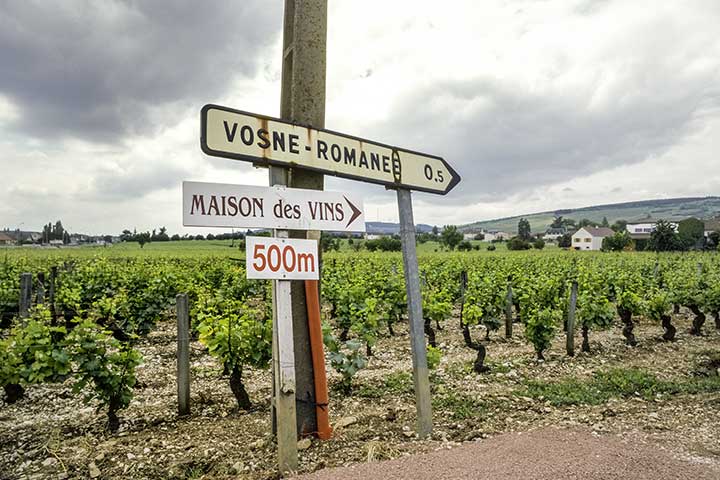
If you don’t already know the name, remember it now: Domaine de la Romaneé-Conti, or DRC for short. Considered by many to be one of the world’s greatest wine producers, DRC is based in Burgundy, and should you ever be so fortunate to get a taste of their coveted Pinot Noir, you should know that you’ll be drinking Earth’s most decadent, and at over $20,000 per bottle, most expensive Pinot Noir. No doubt, the quality is unparalleled, which is one reason why the wine is so costly, but with an average of up to 8,000 cases per year (spread across DRC’s entire portfolio of wines culled from 61.45 acres), the demand immensely outweighs the supply, helping to squeeze the fetching price even higher. So, how much does beloved and esteemed winemaker Aubert de Villaine make from these amazing bottles? Of the DRC Grand Cru wine, he produces about 450 cases. The 2018 vintage goes for $21,995 a bottle. Without knowing for sure if those are 12-bottle or 6-bottles cases, he’s raking in either $118M+ or just a measly $59 million on that wine alone (not counting the other Grand Cru wines he produces). Which is all to say, when Pinot Noir’s good, it’s real good. Beware of counterfeits.

The most luxurious bottles in our cellars don’t cost anywhere near as much, but you certainly get more bang for your buck.

2018 TWO SISTERS LINDSAY’S VINEYARD RESERVE PINOT NOIR, STA. RITA HILLS

2018 CHALK HILL MT. EDEN CLONE PINOT NOIR, RUSSIAN RIVER VALLEY

Your Weekend Itinerary: Sonoma County

If you’ve done Napa Valley, and scoured the Central Coast, you must make time for a weekend getaway in Sonoma County. In fact, you’ll need a LONG weekend to hit all the spots we’ve tacked onto your perfect itinerary, so get ready to sip, dine, and sleep, Sonoma style.

HEALDSBURG

hotel les mars rsz 1 1 1 1 1

Treat Yourself to a Luxurious Stay at Hotel Les Mars
Start your wine country weekend off right when you check into Hotel Les Mars. This intimate, relaxing getaway will make you feel like you’ve traveled to the European countryside, from the moment you set foot in the gorgeously appointed lobby. First-rate amenities, stunning antique decor, and superior service place Hotel Les Mars in a class of its own. Thanks to the hotel’s exclusive relationships with premiere local wineries, the concierge will be happy to arrange a complimentary tasting at one of your favorite Foley properties.

Experience the Cutting Edge of Sonoma Coast Pinot at Banshee
This hip, laid-back downtown tasting room in the heart of downtown Healdsburg has it all: friendly, casual service, a fun, and welcoming atmosphere, great tunes on the record player, and, of course, downright delicious wines. This is a spot you don’t want to miss, especially if you love cool-climate Sonoma Coast Pinot Noir, but there’s something for everyone here, including crisp Sauvignon Blanc, vibrant Chardonnay, refreshing rosé, and an intriguing range of uncommon reds like Carignan and Cabernet Franc.

Bask In the Casual Luxury of Chalk Hill’s Spectacular Property
It’s hard to imagine a more relaxing spot than Chalk Hill’s stunning estate. Set on 1,300 acres, the property features a stunning landscape of vineyards and wilderness areas, as well as the winery and hospitality center, culinary gardens, stables, and equestrian pavilion. Soak up the sun and the stunning views while you taste through Chalk Hill’s diverse range of exceptional estate and Sonoma Coast wines—especially the world-famous Chardonnay wines! Oh, and definitely don’t miss the epic Hummer tour, cheese and charcuterie pairing experience!

Ferrari Carano tasting room open 1

Stop and Smell the Flowers at Ferrari-Carano
Ferrari-Carano is famous for its crisp, and delicious Fumé Blanc, but there’s so much more to this iconic Dry Creek Valley estate. Sustainably farmed Chardonnay, Pinot Noir, Cabernet Sauvignon, and more are all on the tasting menu here, and they seem to taste even better in this spectacular setting. Five acres of gorgeous, colorful gardens provide the perfect backdrop for a leisurely wine tasting experience.

Try a Californian Take on Bordeaux at Lancaster Estate
On the picturesque rolling hillsides of the Alexander Valley, the rich, volcanic soils of Lancaster Estate provide the perfect foundation for Bordeaux varieties like Cabernet Sauvignon, Malbec, and Merlot. For an extra-special experience, try a library tasting or a cave tour, or book a picnic table and bring a meal to enjoy with bottle service in the peaceful Lavender Alcove.

Choose Your Own Adventure at Roth Estate
Stick around the Alexander Valley for a visit to Roth Estate, where you can taste flavorful, full-bodied wines made from classic Bordeaux varieties, as well as elegant, cool-climate Burgundian-style wines from the Sonoma Coast. Enjoy a daytime tasting on the terrace, upgrade to the cave experience and try a premium lineup of Roth wines alongside tasty small bites, or enjoy a seated Korean-inspired BBQ lunch that includes your choice of two signature wines. Or, plan your visit on a Friday evening to partake in Adults at Play, a delightful experience featuring live music and festive food and drink.

Try the Legendary Burger Healdsburg Bar and Grill
For classic, satisfying American food, Healdsburg Bar and Grill is a winner. Everyone in the family, from picky eaters to serious foodies, will be pleased with the menu—the signature HBG burger made Food & Wine magazine’s 2018 list of Best Burgers in the U.S. Conveniently located on the Healdsburg plaza, it’s the perfect place to fill up on delicious food between winery visits.

Enjoy Fresh Seasonal California Cuisine at Chalkboard Restaurant
Just off the Healdsburg town square, this upscale-casual eatery offers contemporary cuisine by Executive Chef Forest Lee Kellogg, inspired by a dedicated local produce garden. Creativity abounds in the flavor combinations and presentations of small plates in this cozy, comfortable spot located inside Hotel Les Mars.

GEYSERVILLE

Expand Your Horizons at Foley Sonoma
Discover the intersection of Old World tradition and modern technology at Foley Sonoma, where the focus is on producing wines of pure varietal expressions, with loads of character. Taste classics like Cabernet Sauvignon, Zinfandel, and Chardonnay, or try something a little different from Foley Sonoma’s diverse range—like Petit Verdot, Sangiovese, Sémillon, or Tannat, while watching the winemakers in action at the state-of-the-art facility. The winery building, designed with small-production, ultra-premium winemaking in mind, won the Architectural Design Award for Northern California from AIA when it was built in 2002.

SONOMA

Taste Elevated, Authentic Mexican Flavor at El Molino Central
This lively, colorful hidden gem is home to some of the best Mexican food you’ll find in Sonoma County. Full-flavored dishes—like poblano-tomatillo nachos verdes, crispy chilaquiles, and beer-battered fish tacos with handmade tortillas—made from fresh, seasonal ingredients, keep locals coming back to this casual counter-service spot. The talented team at El Molino Central never takes shortcuts in the kitchen, and it shows.

Valley Bar and Bottle
There’s a lot of hype around this new restaurant, wine bar, and bottle shop on the Sonoma town square, and every bit of it is well-deserved. Focused on organic, biodynamic, and natural wines, Valley also serves up delicious simple, seasonal food inspired by California home cooking. The friendly staff is happy to make thoughtful recommendations, which is helpful for discovering exciting new wines among the somewhat esoteric offerings. If you can make it for weekend brunch, don’t miss the olive oil cake.

SV Outdoor Tasting v2 1

Taste Sonoma County History at Sebastiani
A short stroll from downtown Sonoma’s charming boutiques and restaurants, Sebastiani’s tasting room perfectly embodies wine country’s relaxed, rural elegance. For more than a century, Sebastiani has been at the forefront of premium Sonoma County winemaking, and today is beloved for its complex, concentrated single-vineyard and single-appellation wines (like Cherryblock Cabernet Sauvignon.)

SEBASTOPOL

Indulge In Seasonal Japanese Specialities at Ramen Gaijin
This buzzy spot is in the center of Sebastopol’s trendy, lively Barlow district, and is well worth a detour. Arrive early for your reservation so you have time to check out the surrounding boutiques and tasting rooms while you work up an appetite. You’ll want to try everything on the menu, which features expertly prepared seasonal, regional ramen, and izakaya specialties from all over Japan. The beverage program, which includes a fantastic selection of wine, beer, sake, and creative craft cocktails, is the cherry on top of this outstanding culinary experience.

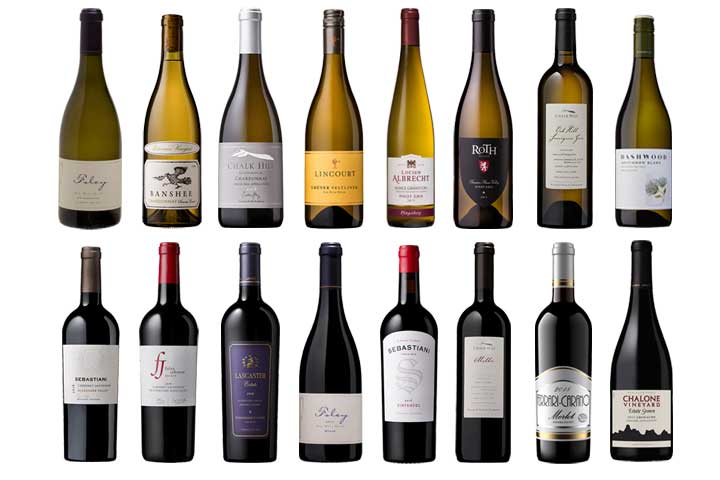
8 Whites and 8 Reds For Two National Wine Holidays

August is finally here! Air conditioners around the country are on full blast, dogs are walking around with their tongues hanging out, and this month we celebrate not one, but two national wine appreciation days.

As we lurch into the second half of summer, it’s a good time to recognize National White Wine Day on August 4th and National Red Wine Day later in the month on August 28th.

It’s as good a time as any to dive deep and stock up on some of the best whites and reds around, but if the only thing you want to dive deep into is your neighbor’s swimming pool, then don’t worry because we’ve got some of our favorite picks to share with you here.

WHITE WINES

5625 560

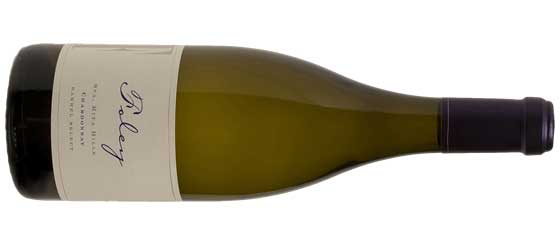
1. 2017 FOLEY ESTATES BARREL SELECT CHARDONNAY, STA. RITA HILLS

A selection of the best barrels from Foley Estate Rancho Santa Rosa Vineyard, delivering a supple, weighty white with notes of apples, lemon, and graham-cracker toast, all gliding to a lasting lime and stone fruit finish.

093727 2018 Banshee Bohemian Vineyard Chardonnay Sonoma Coast

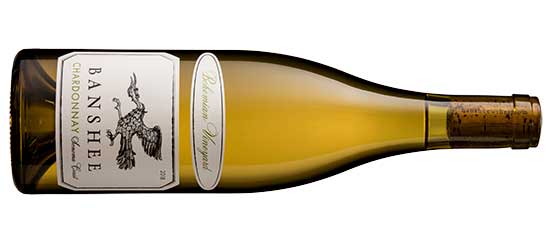
2. 2018 BANSHEE BOHEMIAN VINEYARD CHARDONNAY, SONOMA COAST

Plucked from the Bohemian Vineyard in the Green Valley AVA—a site that is situated in prime coastal territory, just half a mile as the crow flies from the uber iconic Heintz Vineyard. A bright, citrusy Chardonnay with notes of honeysuckle and fine cedar; with zippy acidity.

8185 560

3. 2018 CHALK HILL ESTATE CHARDONNAY, CHALK HILL AVA

A classic!! This vintage earned 92 points from Robert Parker’s Wine Advocate: “The 2018 Chardonnay Estate has lush scents of baked apples, honeysuckle, honeycomb and hay with notes of quince paste and almonds. The palate is medium-bodied, rounded and slightly buttery with a long, uplifted finish.”

Lincourt Gruner Veltliner Bottle Shot

4. 2018 LINCOURT GRÜNER VELTLINER, STA. RITA HILLS

A 100% Grüner from the Central Coast! If you haven’t tried it yet, you’re missing out. Get ready for zesty grapefruit and tangerine aromas; a fresh peach and lemon tart finish. Just a stunner. Enjoy a glass (or two) alongside your best salad recipe.

lucien albrecht pinot gris

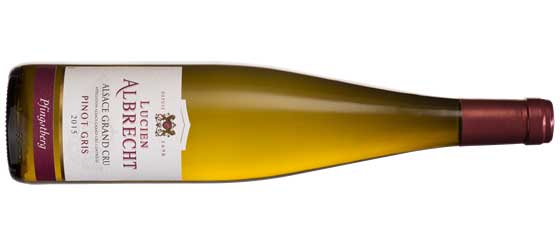
5. 2015 LUCIEN ALBRECHT PINOT GRIS GRAND CRU PFINGSTBERG, ALSACE

From a Grand Cru vineyard in Alsace comes this pear-driven, lemon-tinged, complex white, which earned 93 points from Wine Enthusiast: “Ripe, juicy yellow pear and honey carry the nose. The palate hits with a touch of sweetness that boosts the ripe pear fruit but, it is countered by zesty lemon and a pleasantly bitter streak of phenolics. The result is a rounded, powerful and concentrated wine. Drink now–2028.”

40113 560

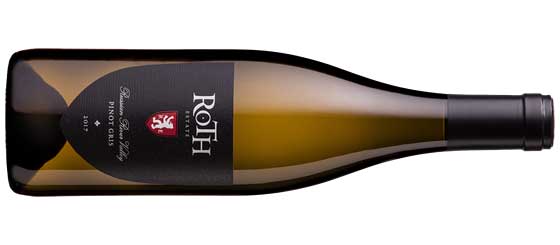
6. 2017 ROTH RESERVE PINOT GRIS, RUSSIAN RIVER VALLEY

Sure, Chalk Hill and Russian River Valley is ground zero for fantastic Chardonnay and Pinot Noir, BUT… it’s also an ideal place for growing Pinot Gris, (a.k.a. Pinot Grigio) which in the Roth cellars is transformed into a tropical delight redolent of mango and pineapple on the nose with flavors of honey, melon, and peach.

Chalk Hill Oak Hill Sauvignon Gris

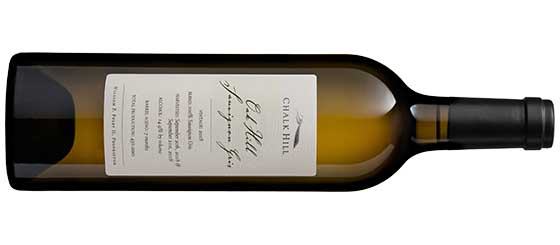
7. 2019 CHALK HILL OAK HILL SAUVIGNON GRIS, CHALK HILL AVA

A pink-hued mutation of Sauvignon Blanc, this Sauvignon Gris grape was aged seven months in 100% French Oak, all native yeast, entirely barrel-fermented and underwent bi-weekly bâtonnage (stirring of the lees), which means it is unctuous and utterly divine! This is one very special white, offering a fantastic blend of lime, grapefruit, and vanilla aromas with pops of exotic spices and lemon cream.

Dashwood Sauvignon Blanc 20201

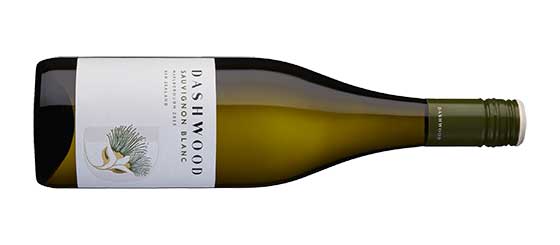
8. 2020 DASHWOOD SAUVIGNON BLANC, MARLBOROUGH

Crisp as only a New Zealand Sauvignon Blanc can be, with lemon and kiwi notes and bracing acidity, which practically demands you pair this with seafood, pasta, salads, and cheese courses.

RED WINES

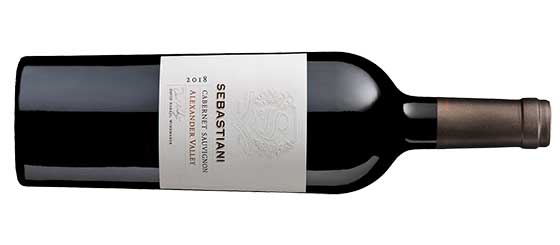
2018 sebastiani cabernet sauvignon alexander valley

1. 2018 SEBASTIANI ALEXANDER VALLEY CABERNET SAUVIGNON

The 2018 growing season is simply one of the all-time best for North Coast California and in Alexander Valley, the picture-perfect year turned out some of the finest Cabernet grapes we’ve ever harvested. This 95% Cabernet with 5% Merlot is a hearty red, with sumptuous aromas of rich black fruit, cassis, vanilla bean, and offers an almost black-tea-like body with more cassis, wildberry sweetness, and elegant flourishes of oak on a long finish.

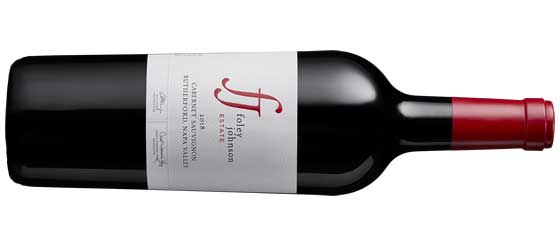
2018 Foley Johnson Rutherford Cabernet Sauvignon 1

2. 2018 FOLEY JOHNSON ESTATE BOTTLED CABERNET SAUVIGNON RUTHERFORD

In Rutherford, we love to talk about the famous “Rutherford Dust,” but what do we mean? We’re really talking about a textural and aromatic element: red volcanic soil, which creates these heady, red-earth aromas and tannins that have a kind of earthy complexity that can only be achieved as a result of vines growing in the famous Rutherford volcanic-rich soils. Here we find cassis and black cherry aromas mingling with chocolate, giving way to those earthy, dusty tannins, framed by black olive and sage spices.

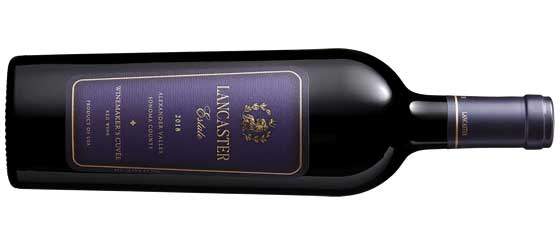
2018 Lancaster Winemakers Cuvee

3. 2018 LANCASTER WINEMAKER’S CUVÉE, ALEXANDER VALLEY

This full-bodied red is making waves, having earned 93 points from Robert Parker’s Wine Advocate: “The 2018 Winemaker’s Cuvée is a blend of 69% Cabernet Sauvignon, 27% Merlot, 2% Cabernet Franc, 1% Petit Verdot and 1% Malbec. Medium ruby, it has pretty scents of Morello cherries, cigar box, lavender and pencil shavings. The full-bodied palate is approachable straight from the bottle, with grainy tannins, refreshing acidity and a long, mineral-laced finish.”

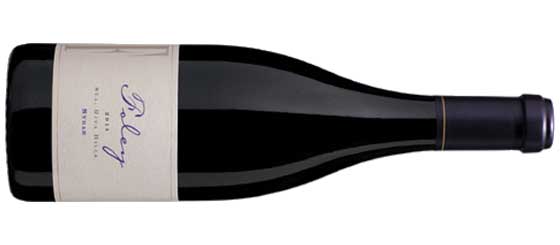
2018 Foley Estates Syrah

4. 2018 FOLEY ESTATES SYRAH, STA. RITA HILLS

Some of the best Syrah in all of the U.S. comes from high-elevation pockets in the Sta. Rita Hills appellation in California’s Central Coast. This Syrah is, in our opinion, among the finest out there—intense flavors of dark fruits are nicely delineated, underscored by savory spices, violets, and meaty tannins with real grip. This is a steak and potatoes wine for sure.

Sebastiani 2018 Sonoma County Zinfandel

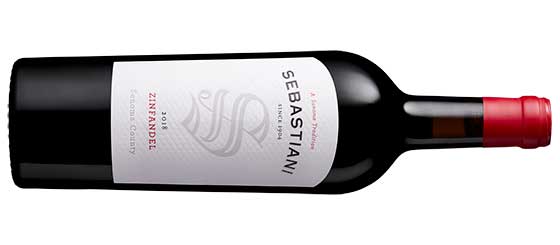
5. 2018 SEBASTIANI ZINFANDEL, SONOMA COUNTY

Is there anything more iconic than Sonoma Zin? Zinfandel is, after all, the OG grape of California and was once more widely planted than Cabernet Sauvignon. In the glass, plum and fig mingle with raspberry and lavish vanilla bean baking spices.

8130 560

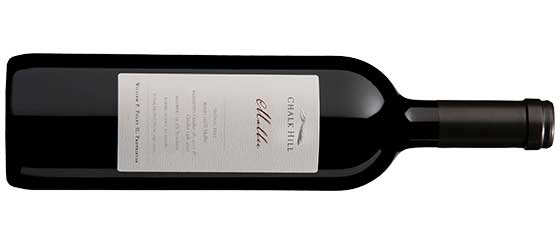
6. 2017 CHALK HILL CHAIRMAN’S MALBEC

Sourced from our 56-acre Estate West vineyard across Chalk Hill Road from the winery, this is your Saturday night Malbec, which we suggest pairing with your favorite Sinatra tune, because ya know—he was, after all, the Chairman of the Board. Getting these two ‘Chairmans’ together will make for a mighty good time: This dark-fruited blend with cherry, vanilla, and wood smoke aromatics is framed by fine tannins and a peppery finish. Make sure you listen to “I Will Drink the Wine”!

142118FC Merlot 2018

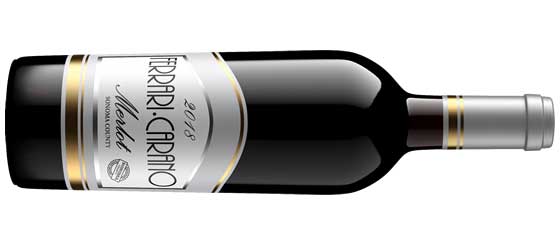
7. 2018 FERRARI-CARANO MERLOT, SONOMA COUNTY

One of our newest members of the Foley Family collection of wineries, we highly encourage you to put aside any ideas you have that Merlot should be relegated to the back seat and pull this one up front, and cruise with the top down (figuratively speaking of course). Smooth with strong berry and clove flavors; a delightfully long finish and a delightfully enjoyable red.

80804

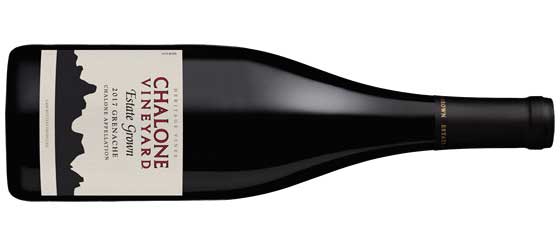
8. 2017 CHALONE VINEYARD ESTATE GRENACHE, CHALONE AVA

From grapes grown in the shadow of The Pinnacles National Monument in the Gavilan Mountains south of San Francisco, comes this stunning, gorgeous, and delectable Grenache redolent of blackberry and raspberry flavors with a potent minerality; oaky, smoky, peppery and frankly, your new best friend. Let someone else walk the dog while you savor a glass or two (or three) while contemplating the meaning of life on National Red Wine Day. To infinity and beyond!

Tips on Home Gardening From The Gardens at Chalk Hill

By Jonathan Cristaldi

This is part two in a mini-series of visits to the Chalk Hill estate gardens in Sonoma. And as I said in my first report, nothing in the world compares to the taste of fruits and vegetables, plucked from a sustainably farmed garden, and nibbled on—while standing in the garden. This time, instead of strawberries, I was nibbling on an array of peppers and basil, all featured below.

The gardens at Chalk Hill are cultivated by two all-star gardeners. Brad Agerter, the Estate Culinary Garden Manager, who, incredibly, has spent 13 years working the beds. Joining him is Scott Pavlick, the Assistant Garden Manager, who has been dusting Chalk Hill dirt off his boots for four years.

Before touring the gardens, I asked Brad to impart some practical advice for the home gardener. This is what he had to say:

PLANTER BOXES VS PLANTING DIRECTLY IN THE GROUND

Brad: “If you have a big enough space and can plant in the ground, you just have to make sure the soil is healthy. Planter boxers are great because if you’re embarking on small scale gardening you can put gopher wire under the box which will help with a lot of problems in the beginning, and you can pick the best soil to fill the boxes with.”

THE DIRT ON POTTING SOIL

Brad: “For larger scale planter boxes, you could go to a big soil place like Soils Plus. Given we’re in Sonoma, we have a lot of local options. Nearby Chalk Hill is RAMM Rock & Landscape Supply, which has an array of potting soils. I’d suggest seeking advice from your best local potter. We also use Grab N’ Grow Soil Products. The thing to note is how much soil you’ll need. You could spend $12 on one bag of potting soil at a local supplier like Home Depot, but if you’re trying to fill a half wine barrel full of soil, you might need three bags of that soil. But if you go to a place like RAMM Rock or Grab N’ Grow, and get a yard of soil, which would fill a standard pickup truck, you’ll spend maybe $150, and have more soil than you’d know what to do with (more planter boxes!) Don’t buy bag after bag!

Brad: “Most importantly, the soil needs to have good drainage, but should be able to hold moisture and have good nutrients. I always suggest getting extra compost, which has a lot of microorganisms that digest soil and process nutrients for the plants while leeching out toxins and such.”

THE DEAL WITH WATERING

Brad says that if you have a small enough garden and can water yourself everyday do that, as you’ll save money on potentially expensive installations of drip or sprinkler systems.

“We have long row crops at Chalk Hill and use drip irrigation. But a planter box might have a lot of varying plants that require different amounts of water. You can get emitters that regulate water use. Say, you have cucumbers growing next to tomatoes. You’d install a smaller emitter on the cucumber plants, which lets out less water while a larger emitter on the tomatoes offers more. There are all kinds of tricks. If you can afford it, install a timer on the emitter and set it and forget it! Set your timer and go to Italy and have your tomatoes when you get back!”

WHAT TO PLANT WHERE

“Most importantly, you need to know what USDA growing zone you’re in. We live in zone 9 in Sonoma. The zones are climate and weather dependent. They’ll help to ensure you don’t plant the wrong thing in the wrong season!

And in terms of getting going, you have to decide if you’re planting from seeds or going with starter plants from a nursery. You want to find a really good nursery that has a good quality ‘start’ or you have to do a lot of seed work in a greenhouse. Home Depot has whatever they have and could he root bound and struggling and watering could be irregular and plants could be stressed out. So be sure to ask a lot of questions before buying. We got to Harmony Supply, which sells seasonal starter plants, so we know they are growing things well within our zone. One of the best places to find great starts is a local farmer’s market. There will be local farmers leveraging their greenhouses to create good starter plants. They will know what is seasonal and popular.”

THE FIRST FEW DAYS OF PLANT LIFE

Brad: “Weed everyday. Don’t let those weeds go for more than a few days because big weeds mean you could be pulling up the roots of your good plants too. Water new plants in very well so they marry with the new soil. And above all, pay attention! If the plant is not looking good you are over or under watering. And one note about aphids. We use an organic insecticidal soap—it’s called Neem oil and is mixed with water and it gently adds a layer of coating that bugs won’t go near. We also grow other plants that are habitats for the good bugs. I like the Yarrow flower, a big white flower that attracts parasysitic wasps that attack aphids. They’ll also attract lady bugs, which eat the ahpids! Good luck!”

SUMMER OF GARDENING AT CHALK HILL

So, just what is growing in the gardens now, in the summer of 2021? Let me take you on a personal tour.

chalk hill garden squash 1

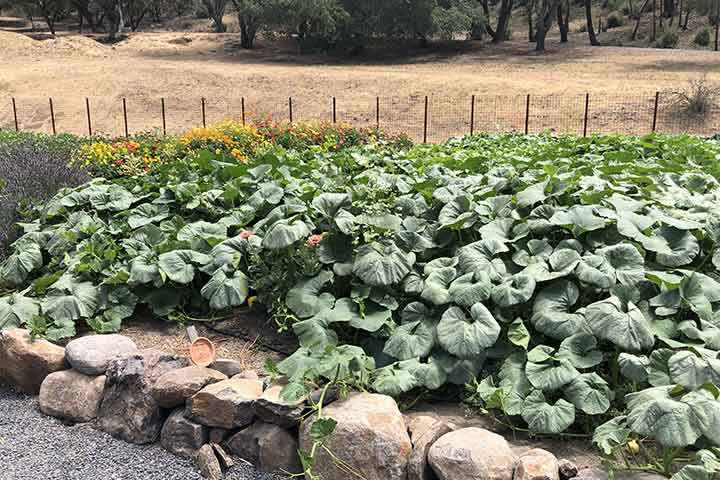
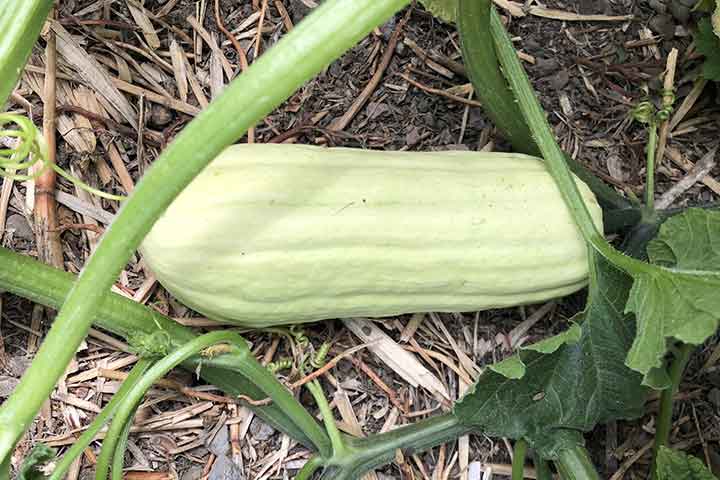
Kabocha—a winter squash. Dark green and hard-skinned. “Makes great pies,” says Brad. “I make a Kabocha tart. And we’re also growing red curry which is long and red on the outside and of course, we have butternut squash.”

chalk hill garden squash 2

Underneath the Kabocha canopy, is Purslane, which according to Brad is a weed, but a tasty, harvestable weed, which the Foley culinary team uses in salads and the like.

chalk hill garden squash 3

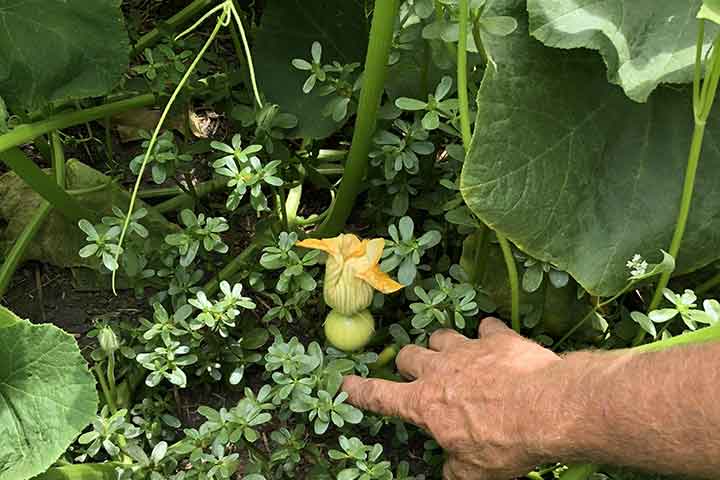
Squash blossoms!

chalk hill garden squash 4


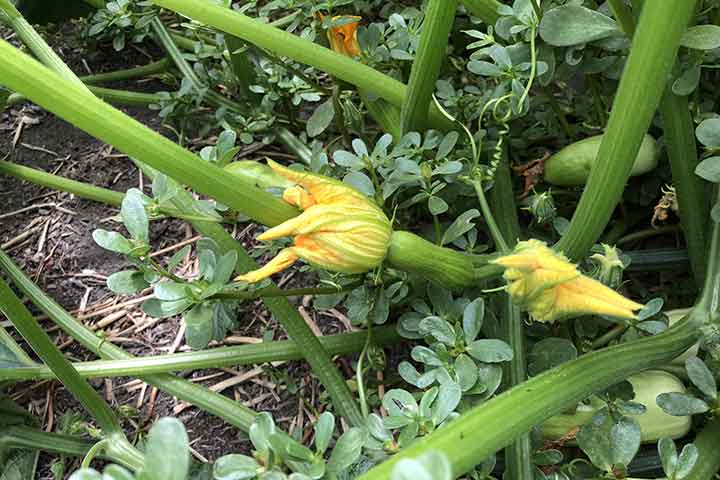
A young squash!

chalk hill garden summer 5

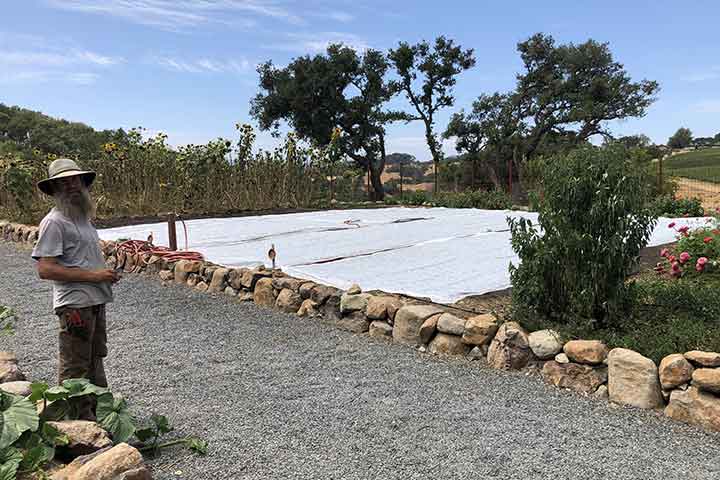
The field with white row cover cloth was planted to beets, carrots, and potatoes when I last visited in late March. Now, there are carrots, beets, and radishes planted, along with an array of nice flowers (far right) and sunflowers (far left) aimed at keeping the birds interested in what’s going on there, as opposed to taking delight in the young seedlings beneath the white cover cloth. That cloth is pretty useful — it allows seventy-five percent of light to penetrate, while providing some frost protection, and also helps keep out bad bugs.

chalk hill garden summer 6

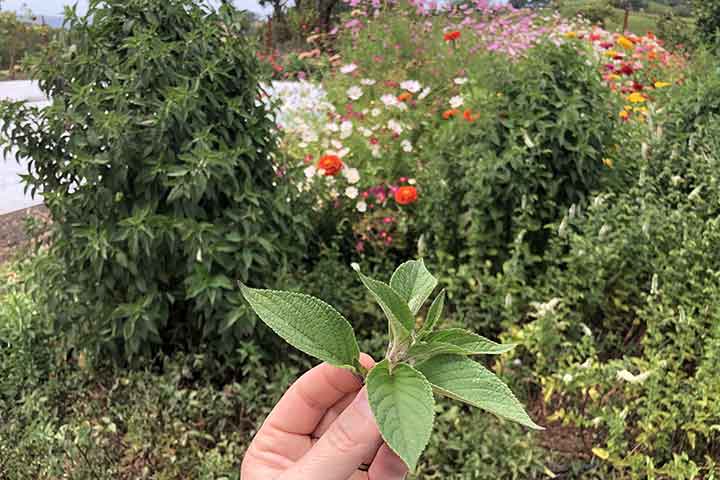
I’m holding a few leaves of Pineapple Sage, which has a tropical pineapple aroma and flavor, and is one crazy versatile herb you can add to—whatever your heart desires. I decided I would mull it in a Paloma cocktail of tequila, grapefruit, simple syrup, and sparkling water.

chalk hill garden summer 7


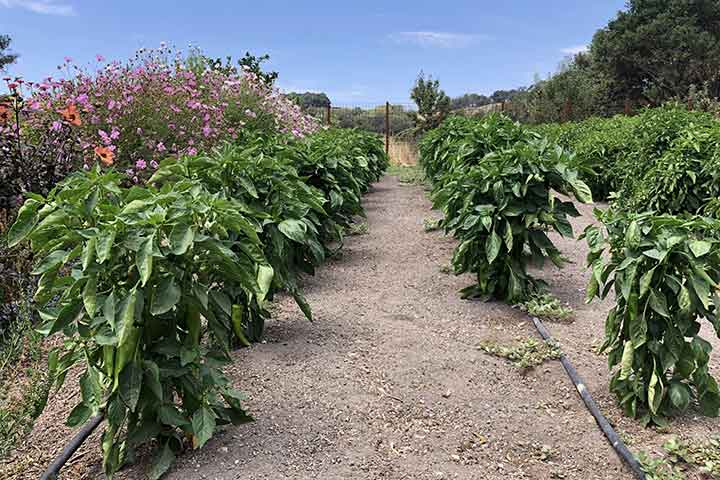
In these rows, we’re looking at sweet peppers: Cornito Rosso (left) and the next image is of young, Jimmy Nardello peppers, which become longer and vivid red, and are sweet.

chalk hill garden summer 8

Jimmy Nardello peppers.

chalk hill garden summer 9

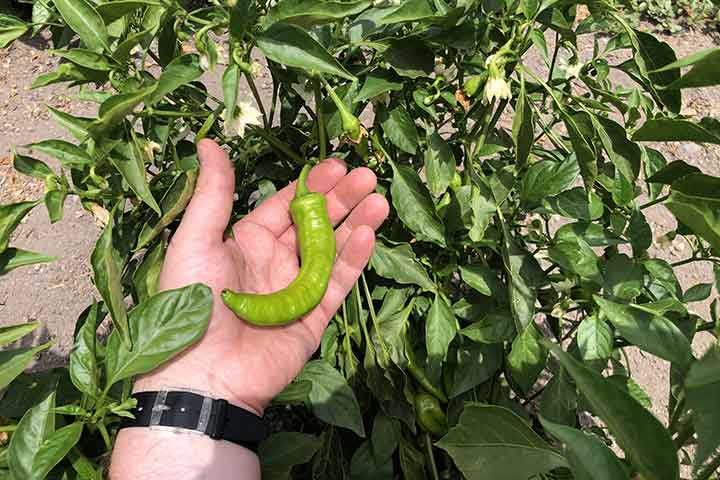
Jimmy Nardello peppers compared to my hand.

chalk hill garden summer 10

Also some Habanado peppers — these have Habanero flavor without the heat.

chalk hill garden summer 11

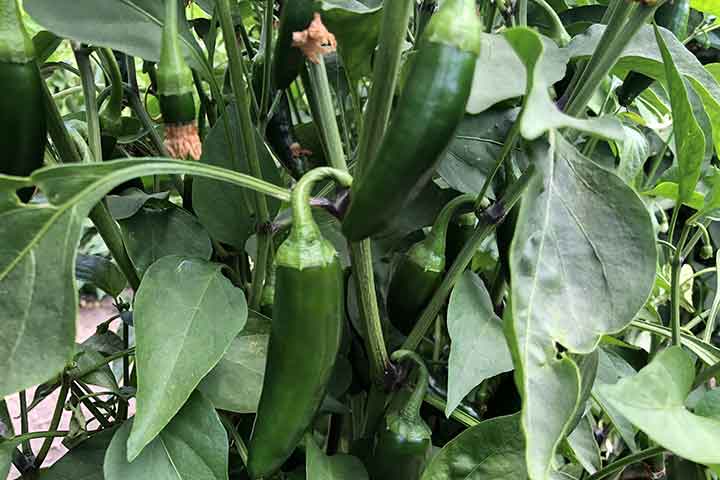
Also growing are Jalapeños!

chalk hill garden summer 12

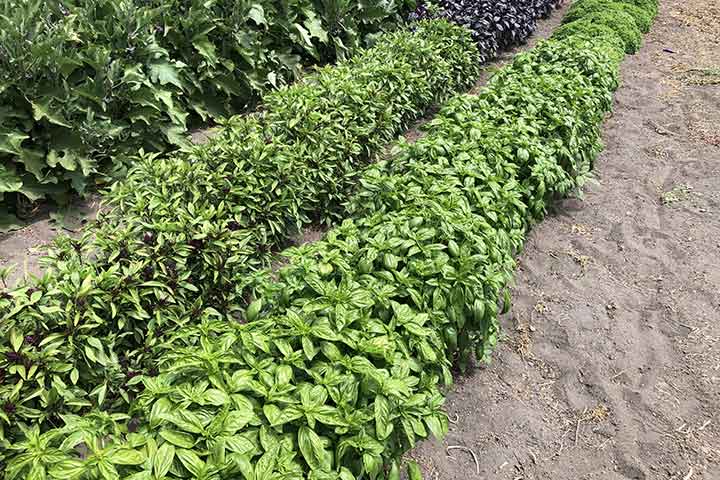
Pictured left is Thai Basil and right is Genovese basil (the typical basil you’d get in the grocery store) and interestingly, the purple basil on the end, in the upper left is also Genovese.

chalk hill garden summer 13

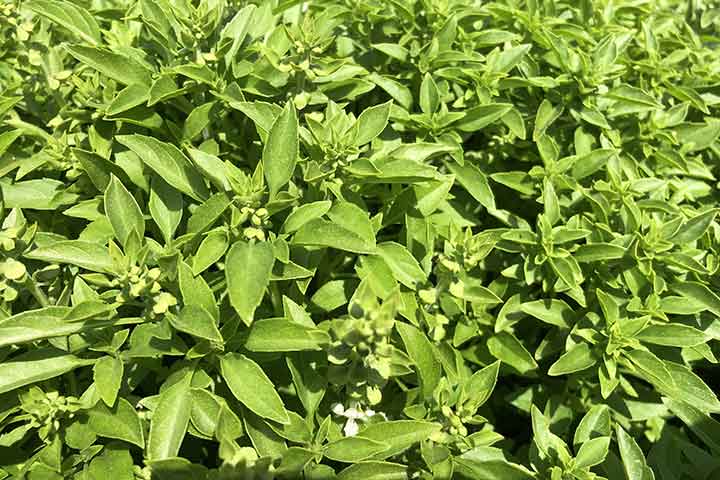
And this is “micro basil,” as Brad refers to it, noting that the Foley estate chefs “use it as a pretty garnish, typically.”

chalk hill garden summer 14

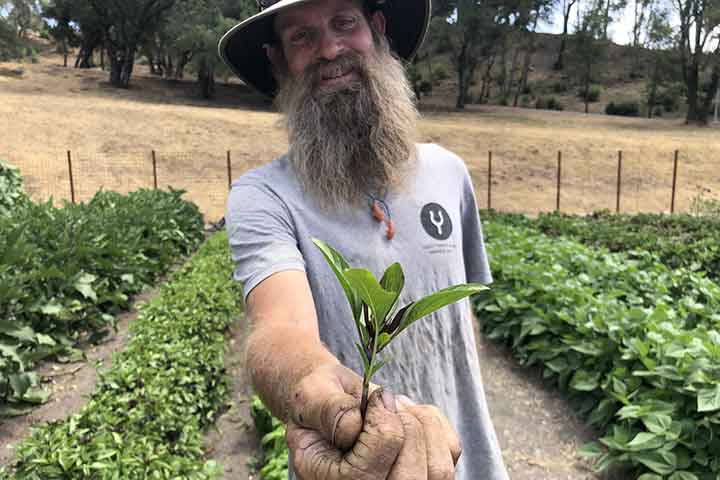
Brad showing off some Thai Basil. (Did you notice the Foley Food & Wine Society logo on his shirt!?)

chalk hill garden summer 15

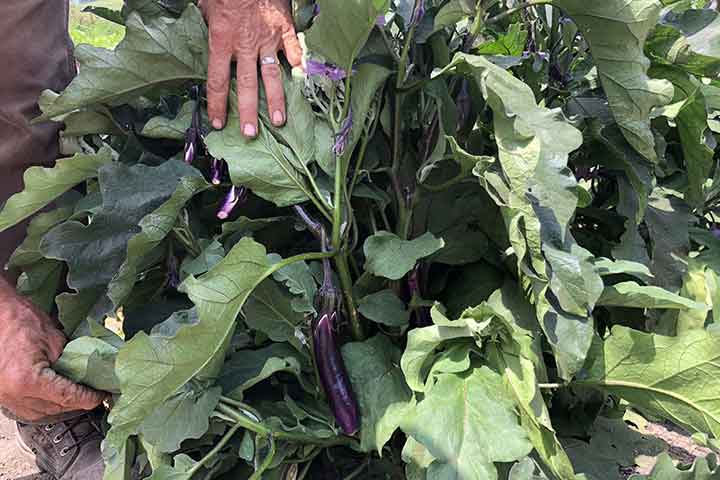
These are Japanese eggplants.

chalk hill garden summer 16

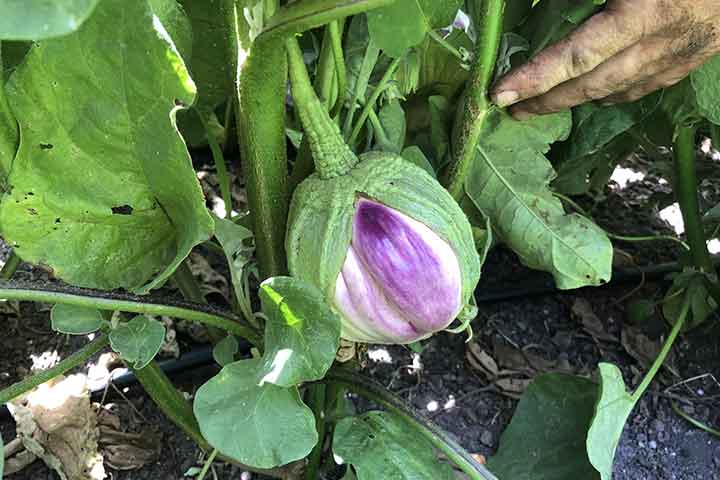
Here we have Rosa Bianca eggplant, an heirloom variety. If you like eggplant this one gets fat and round and “is royally tasty,” says Brad.

chalk hill garden summer 17

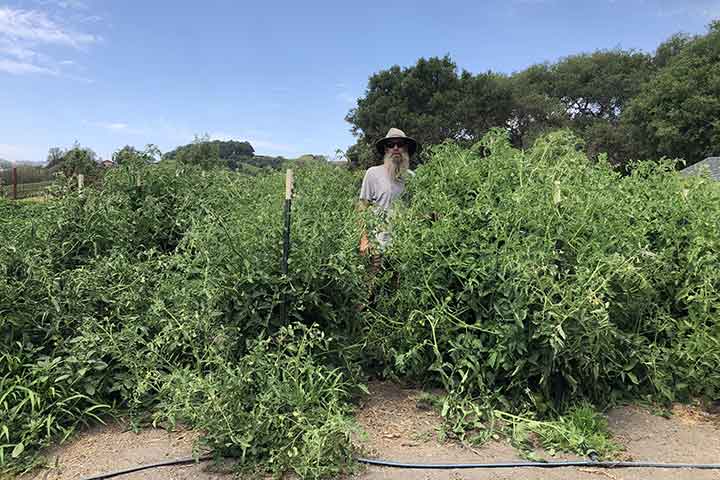
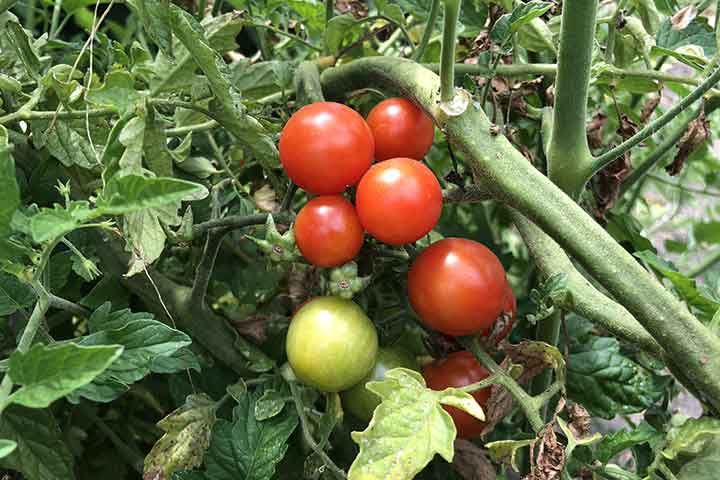
The next four photos are of the young tomato vines growing, but note, courtesy of Brad standing in the middle of one of the rows, how tall they are after only a very short time in the ground.

chalk hill garden summer 18
chalk hill garden 20
chalk hill garden summer 19
chalk hill garden summer 21

Here in the second garden, we’re knocking on watermelons! Two different kinds of melons are growing: Sugar Baby and Crimson Sweet. “You knock to hear a hollow sound and that tells you it is ripe. If you get a thud, give it more time,” says Brad.

chalk hill garden 8

Plan your visit to Chalk Hill now. Come for the gardens. Stay for the wine. 

Winemaker Spotlight: Christina Zapel of Foley Sonoma Winery

After trying her hand working in a winery tasting room on Long Island, then living in NYC working in restaurants, Christina Zapel landed a gig at Wine Spectator magazine. Her brief foray into wine journalism didn’t last long, and before she knew it, the cellar was calling.

Today, Zapel is the winemaker for Foley Sonoma, a very cool property we hope you’ll consider visiting soon. For now, here’s your chance to get to know Christina, and also to check out her recommendations for diving head-first into Foley Sonoma wines.

foley sonoma

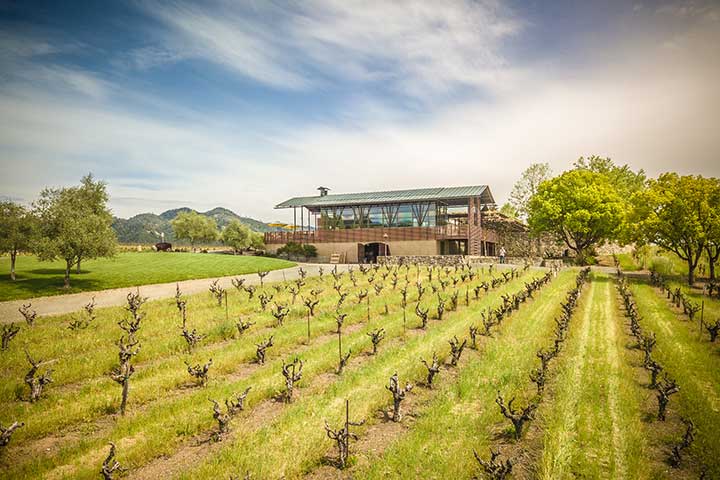
Foley Sonoma Winery in Geyserville, California.

FFWS: We have a lot to unpack here! First of all, you’re a New York University alum with a BS in nutrition and food studies. Out of school you worked at magazines and tasting rooms on Long Island. Tell us about this time!
Christina Zapel (CZ):
 I studied Nutrition and Food Studies since I always knew I was going to do something in the food industry and was aiming to be a food writer or work in journalism. My internships in college centered mostly around the media. I interned at Good Housekeeping one semester, and at The Rachael Ray Show another semester. The summer I graduated, a fellow student suggested we go work at a winery for the summer out in the Hamptons. Since that sounded wonderful, I agreed and ended up loving it. After working in the tasting room all summer, I moved back to NYC, decided to study wine, and earned my Advanced Certificate in Wine and Spirits from the Wine & Spirits Education trust.
Since it was 2008, and the economy was terrible for a college grad, I worked in restaurants to pay my bills. I wasn’t in a rush to get a “real” job, with benefits and what-not, and wanted to find something I was passionate about.

I kept returning to the winery for a few summers, since I couldn’t resist working summers in the Hamptons. I ended up leaving that job once I got a job at Wine Spectator in the tasting department.

FFWS: What inspired the switch from journalism to winemaking?
CZ:
 After two years working in a tasting room at a winery in New York, and selling wine at special events, I was approached by the winemaker at Three Sticks and asked if I had any interest in learning to make wine. So that’s how it happened! He noticed that I worked hard (but mostly that I could carry heavy items unaided!) and that was that! It was difficult and hard and I questioned why I said yes, but really, it changed my life. I ended up leaving this position for Wine Spectator, because the magazine was just too good of an opportunity to pass up, but really missed winemaking while working there. I made the decision to leave the magazine, and NYC (where I lived for basically 7 years) and moved to Sonoma County to pursue winemaking!

FFWS: You spent some time in Australia, then back Stateside at Lynmar before landing at Flowers. Who were you learning from along the way?
CZ:
 The time in Australia was really my first experience making wine using native yeast fermentation and sustainable farming. I was always interested in making wine this way and was glad when the winery in Australia offered me a chance. I went with my then-boyfriend/now-husband, and we worked for a winemaking couple, Phil and Rochelle Kerney. The winery was Ross Hill in Orange, NSW but the winemakers have since moved on to their own brand. Since we were the only two interns, we had a lot of one-on-one time with the winemakers. We’ve kept in touch with them in the years since.

Flowers was another opportunity to make wine with native yeast and minimal intervention in the winemaking process. The winemaker, Chantal Forthun, who is also a friend, was a great mentor. She encouraged experimentation and was always brainstorming new ways to improve wine quality or style. She also encouraged the opinions and suggestions of others on the production team in her constant quest for improvement.

Even though the Australian winery and Flowers had the most impact on my winemaking style, all my internships and experiences helped give me the knowledge and skills I have today. Each place taught me something unique and there is always something to learn.

FFWS: How did you end up at Foley Sonoma and what excites you most about the estate? Tell us a little about the history of this winery too—Bill Foley purchased it in 2016.
CZ:
 Before it was purchased in 2016, it was Stryker Sonoma. What excites me most about Foley Sonoma is the chance to work with small batches of fruit grown right outside my door, including fun varieties like Tannat and Sangiovese. We also make a Zinfandel from vines that are over 100 years old!

FFWS: Tell us a little about your cellar at home – what do you like to drink when you’re not tasting your own wines?
CZ:
 Mostly, gin & tonics! But in all seriousness, Champagne and other sparkling wines are something I will always drink, no matter what, forever and ever. I have many favorite producers; it’s too hard to narrow it down! I really love a good Chardonnay, especially coastal Chardonnay or white Burgundies. Since I live and breathe California wines, we try to drink old-world wines at home. Some of our current favorites are Chenin Blanc from the Loire and Sicilian reds. I love a good Chianti or Brunello for special nights.

085030 Foley Sonoma 2016 Estate Tannat

FFWS: For any FFWS members new to Foley Sonoma what wines in the portfolio would you recommend they start with? For those who have been in the know since the first vintage of Foley Sonoma, what would you say is the most out-there bottle to try next?

CZ: For new members, I would recommend starting with the 2018 Estate Chardonnay [currently sold out, look for a new vintage release!]. It’s a mineral-driven style of Chardonnay with refreshing citrus fruits and a hint of oak. For those looking to try something, I’d say either the Courtney’s Cuvee [currently sold out, look for a new vintage release!], a red blend of the best barrels of the vintage, or the Tannat. Most people haven’t had a Tannat before, so it’s a great opportunity to expand one’s palette!

July 4th Wine Picks and Food Pairings From Our Winemakers

There are many reasons to celebrate this coming Independence Day. For one, as of the end of June, 66% of Americans have one vaccine shot, and 57% are fully vaccinated, according to the New York Times, and mask mandates have lifted around the country. Translation: the parties are on. We hope you take this time to reflect on the past year, on what you’re grateful for, and certainly hope you lift a glass to the Founding Fathers who drafted the Declaration of Independence, which was approved by Congress on July 4, 1776.

To help inspire your celebrations and family reunions, three of our Foley Family Winemakers have shared what special wines they plan to open and what food they plan to pair with those wines. So, here’s to the red, white, and bubbly weekend ahead, and hey—we want to hear from you! Don’t forget to tag us in your social posts! Follow the Foley Food & Wine Society on InstagramTwitter, and Facebook. Cheers!

Chalone Winemaker Greg Freeman 720

Greg Freeman, Winemaker, Chalone Vineyards

Greg Freeman (Chalone Vineyards): I’m having local musician friends over for a backyard jam, music, and food fest. I play the guitarist and am a bagpiper! I anticipate the weather being hot, but being in Carmel, not too hot, so I’m planning to open a 2020 Pinot Blanc and a 2019 Syrah, both from Chalone Vineyard.
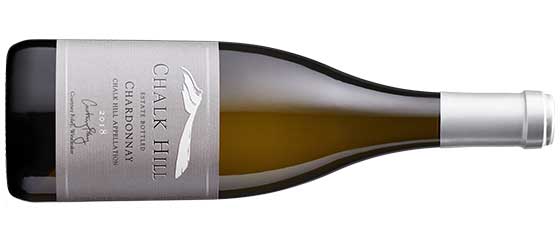
The Pinot Blanc is big and luscious, has the body of a big Chardonnay with the oak and butter component, very satisfying wine, and refreshing to boot, nice acidity, and clean fresh aromas. The Syrah is for when the steak comes off the grill, the fatty meat will pair perfectly with the cool-climate Syrah, fresh red berries, white pepper, and raspberries. Dark inky and immensely opulent aromas, grippy tannins! Yum! [Editor’s note: the Pinot Blanc is currently unavailable, however, the 2017 Syrah ($40) and 2017 Estate Reserve Pinot Noir ($55) are up for grabs!]

My go-to meal is something from the grill, including corn on the cob and asparagus—fresh produce from a local organic source is the best way to have an amazing healthy sustainable meal that everyone loves. I plan to cook bone-in ribeyes. This tends to be a fatty cut with tons of flavor, and expensive, but it is a special occasion, so I go big. The Chalone Syrah will be perfect with this dish. The corn is sweet and the asparagus is crisp and fresh—both with butter and sea salt is all it takes. If I can score a bottle of Lincourt Pinot Noir by the Fourth, I will have that, too. My fave!

Sebastiani Winemaker, Mark BeamanMark Beaman, Winemaker, Sebastiani Vineyards & Winery.

Mark Beaman (Sebastiani Vineyards & Winery): I am going to pop open a bottle of chilled 2017 Chenin Blanc Method Champenoise sparkling I made while I was at Maui Wine. Unfortunately, abalone season has been closed, which cancels my first pairing choice. My backup is if I can find fresh ahi tuna I would make a traditional Hawaiian poke with sesame seeds and a drop of sesame oil, mild ginger, lemon juice, avocado, and low sodium Shoyu [soy sauce].

We also recommend the 2019 Sebastiani Sémillon ($30) sourced from the Lyon Vineyard near the Russian River Valley in northern Alexander Valley. Crisp orchard fruit with pops of citrus and a streak of minerality make this an ideal pairing for poke, or sushi-grade ahi tuna.

Giovanni Verdejo Foley Johnson 1

Gio Verdejo, Winemaker, Foley Johnson

Gio Verdejo (Foley Johnson): First up, I plan to open a bottle of Foley Johnson 2019 Sauvignon Blanc ($24), because as the temperature begins to near 90 degrees (I’m certain it will), nothing is better than refreshing, low alcohol, citrusy Sauv Blanc to sip on while getting the grill going.

For dinner, I will open a 2017 Foley Johnson Peral Vineyard Cabernet Sauvignon ($120, 91 Points, Wine Spectator), the big round and velvety tannins will pair amazingly with any red meat.
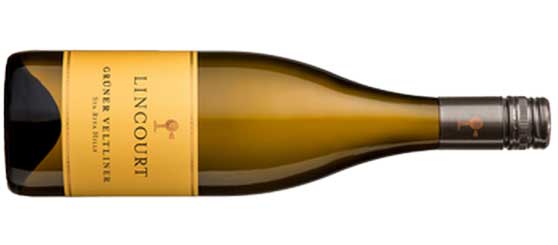
And I love to prepare red meat on the grill. I’ll have a Ribeye roast, which I love to slow cook on my Weber kettle, marinated in a butter mix with rosemary, thyme, garlic pepper, and sea salt, grilling on indirect heat at around 250 degrees for roughly 1-1.5 hrs (per pound)—my mouth is watering as I write this!